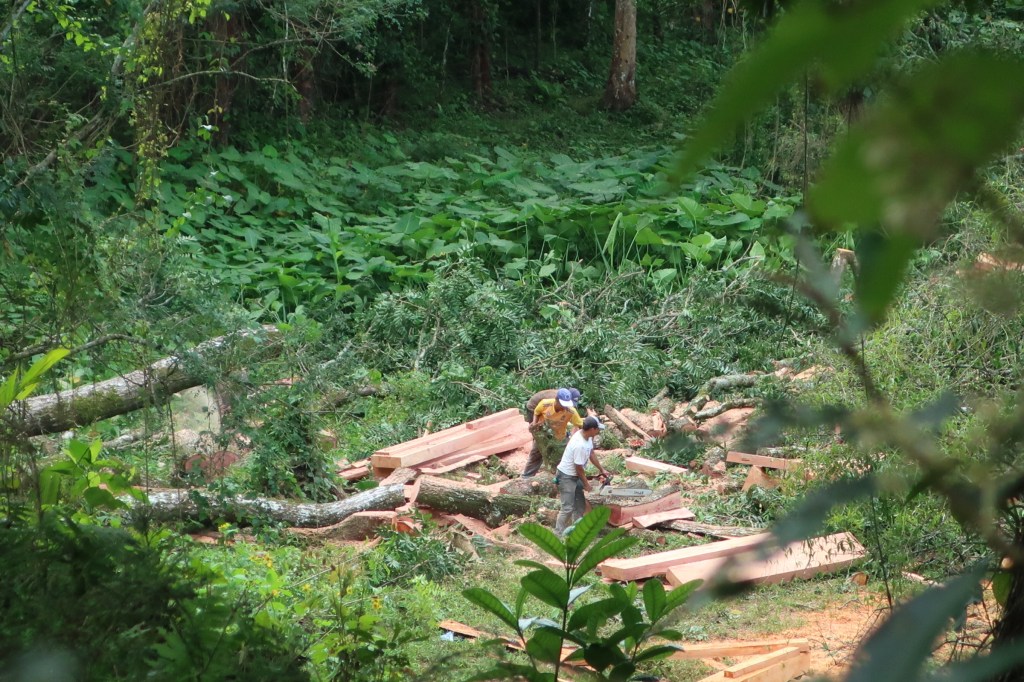
In pre-columbian times, before cattle and the associated pasturing, this place must have been the Earth’s greatest striving at purely aesthetic ends. And the better parts of that glory’s corpse are still appreciable: jagged, cloud-soaked peaks still sport clinging cloud forests, or bosques nublados, everywhere that the sheer grade of the land alone spared itself from grazing. These peaks are promontories above the lower, alluvial rolling lands that slope gently down from the Sierra Madre Oriental to the shores of the gulf coast. These lower slopes, being so kind to the hoof, have preserved but fragments of their original organic architecture that serve as the reminders of a past when far denser forests blanketed the land. This terrain, down below the crest of the Oriental, technically qualifies as lowland tropical rainforest. And it certainly receives the rain and sunlight to qualify as such, yet being on the tropics’ high latitude extremity, nights in the wintertime can hover around the upper 40’s (°F) when the weather system known as El Norte brings cold inundations of air down south over Mexico’s eastern seaboard. Despite this, the region is, or rather would be, very much tropically forested if it hadn’t been so devastated by cattle and the clearing of the land for their pasturing. However, despite this all there are still many hectares of secondary forest on this landscape, and though populated with non-natives such as mango, banana, and citrus trees, these forests are still verdant beyond belief and loaded with an incredible abundance and diversity of birds in particular.
I must admit, however, that to my naive foreign eyes, the true denuding of this land’s biological inheritance is hard to perceive. To someone accustomed to California grazing lands, even the evidently clear-cut pastures here appear to be verdant gardens of beautiful large-leaved forbs. It is only with time that I’m coming to see these “gardens” as simply the tropics’ version of California’s lifeless, overgrazed bald hillsides. The original megafauna diversity has been all but extinguished— “Misantla” means “Place of the Deer” in Totonac, and is now largely without deer, and similarly devoid of the rest of the large megafauna that would have called this place home in the past, due almost certainly to the limits that severe habitat fragmentation places on species with large territorial requirements. That all being said, seeing tropical fireflies amid rainforest trees and to the tune of tree frogs delights both the child and the man in me. I have so far heard, but not seen, my first tropical owl (Strix virgata). I deeply await that first glimpse.
 PeterVanderBloomer.com