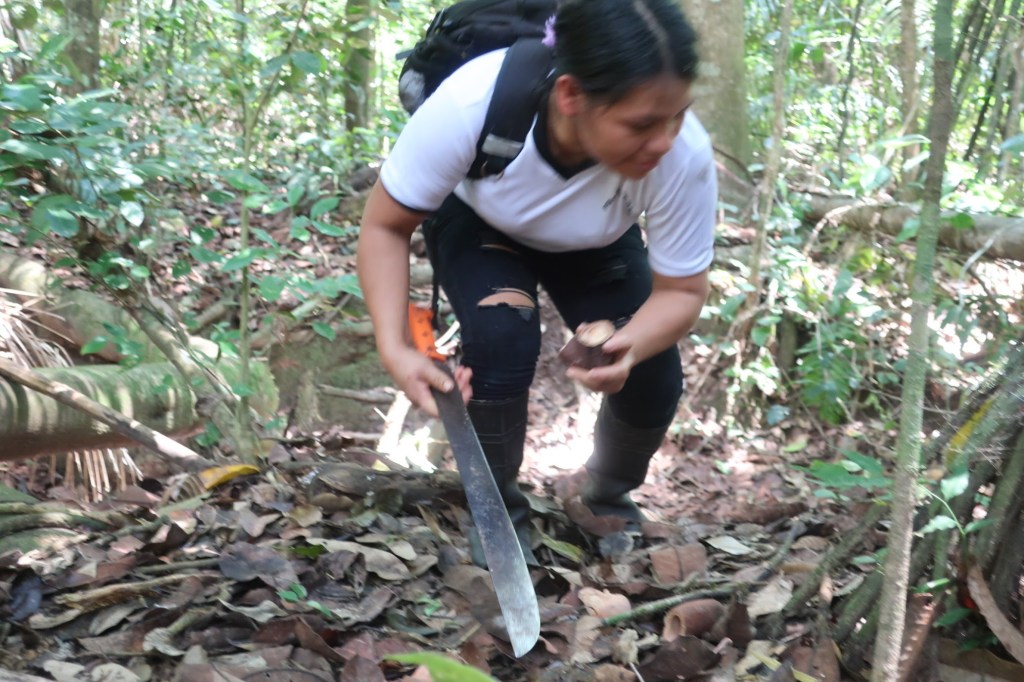
I haven’t quite figured out why I was drawn to Amazonia. Was it simply the understandable allure of lush, rainforest vegetation and its accompanying assortment of a diverse and spectacular fauna? Or was I looking to find something in Amazonia that was lost over a century ago in the lower 48 states—namely, intact indigenous societies as yet uncoupled from the global economy? Both of those things are certainly true, but the real motivation that pulled me down here feels different in some crucial way that I’m still working out. But perhaps most importantly, the deeper my mind has been drawn into this place the more poignantly I’ve come across signs pointing me home. This process actually began at the very beginning of my Latin American journey in the city of Monterrey in Mexico’s far northeast over a year ago now, but I wasn’t ready back then to interpret what I was seeing. Starting in Monterrey, and continuing in every city, town, village, and countryside between there and Perú, I’ve had the same conversation time and time again with taxi drivers, shoe shiners, restaurant workers, farmers—you name it.
Stranger: “¿De dónde vienes joven?” (Where are you coming from young man?)
Me: “De Chicago, en los Estados Unidos. Yo crecí alla. ” (From Chicago, in the U.S. I grew up there.)
Stranger: “Híjole. Ese es muy lejos de acá.” (Wow. That’s very far from here.)
Me: “Si. ¿Y tú, de dónde eres?” (Yeah. Where are you from?)
Stranger: “Soy de acá.” (I’m from here.)
Everybody, everywhere I’ve been, is always, and simply, “from here.” I’ve stopped even asking. In the U.S. this is a perfectly legitimate question, as we move and shuffle around like the brownian motion described by heated molecules. In Latin America, that question is a begging of the obvious, almost laughable. Everybody lives out their lives where they were born, where their parents reside, where their grandparents are buried, where they are recognized in the street—you get the point. It had never dawned on me before this trip that the thing we disparagingly call being a ‘townie’ in the U.S., i.e., someone who never leaves their hometown, is actually the way that most of the rest of the world simply lives out their lives. The fashion, amongst a large sector of the American populace, is to exude a sort of cosmopolitanism—to be worldly, through travel, through taking jobs on the other side of the country (or planet, for that matter). There is undoubtedly something to gain from travel, from living away from home. But in this questing for a spatial knowledge of the world, one sacrifices the temporal knowledge that comes from watching a single place and its people change over the course of time. After more than a year of travel now, I’m also beginning to question whether the traveler actually even gains spatial knowledge of the world by moving around it. To actually know a place, you kind of have to live there. For how long? I can’t say. But I can say that by maybe the four to five year mark in San Luis Obispo, I started to feel like I was sinking into the place. By year seven certain trailheads were starting to feel like long-time friends, certain streets held deep memory banks. Had I passed through San Luis “on a trip,” none of that could have been said. So what would I have added, spatially, to my knowledge of the world by visiting? In broader terms, what does travel actually give us? Certainly something, but we mustn’t forget that whatever is gained comes at the expense of time lost in whatever place you call home. To say the least, I’ve grown deeply skeptical of travel. But that in itself has been the great lesson. Without leaving home, I never would have learned what a fool’s errand it is. Or rather, how incredible it can be to resist cosmopolitanism—to devote oneself not to traveling across the Earth, but to experiencing a single place deeply through time. Amazonia is where that lesson was really brought home to me.
I now have a handful of friends who grew up in indigenous villages—villages that subsist entirely on hunting, gathering, and farming. This is the strongest case that exists for what we in America call being a ‘townie.’ A more benign term would be a ‘local.’ My favorite of all is the Spanish version for this, un lugareño, which is not quite a literal translation for ‘a local.’ Lugar means ‘place’ in Spanish, and therefore a lugareño/a is a man or woman ‘of (a given) place.’ In these indigenous folks, I found striking examples of what it means to be ‘of place.’ The extent to which they represent an intimate relation with their environment is hard to overstate.
On an expedition about two months ago down towards Puerto Maldonado, I got to know a Matsigenka man named Jhonathan who grew up in one of the native communities located within Manú National Park. He served as one of the boat drivers for our journey, as well as a scientific aid for the data collection. To begin with, he knew the plants and animals of the region better than any of us “ecologists,” drawing into question what it was that we actually considered ourselves to be educated in. Science, even ecology, simply does not cultivate the broad scope of awareness that one develops through a lifetime living in a place. Science works through a highly constrained probing of a given system. It’s like walking at night through the forest with a flashlight, where one’s entire focus is restricted to a narrow beam of light. Clearly, the environmental education that life in a native community provides is of an entirely different type. Perhaps it’s more like allowing one’s eyes to adjust to the nighttime forest, and perceiving the environment as a whole, lit in soft moonlight. Safe to say, any and all lingering conceptions that I had of the superiority of science or scientists collapsed pretty quickly. In Amazonia, the boat drivers, without a degree to their name, are better ecologists than the best of the formally trained ones that come down here to study. And better by a large margin, as if we were not even playing the same game. The other day I was speaking with anthropologist Glenn Shepard jr. about this subject, and he said something along the lines of,
“You can find an ecologist who knows a given taxonomic group better than them [the indigenous folks], but you can’t find one who has an equal depth of knowledge across the ecological spectrum. For example, an ecologist will come down here to study, say, Malvaceae [a plant family] and they might be better able to distinguish between species in that family than anyone else. But ask them to do the same with say, Fabaceae [another plant family], and they will be totally out of their element. The Matsigenka, on the other hand, will be familiar with species in essentially every plant family in this forest, let alone the mammals, birds, insects, fish, etc.”
And you must also keep in mind that their knowledge is of course not limited to identification alone. They know how and where and when to catch each species of fish or game, which necessitates a thorough understanding of animal behavior, and then how to perfectly, and quickly, gut and clean and cook each one. They know in which logs at which stage of rot to find Suri, the popular beetle grub delicacy. They know which plants to use for body painting, to remedy snake bite, or to use to treat the atrocious tropical disease leishmaniasis. The list goes on. I had of course read these sorts of accounts of Traditional Ecological Knowledge, as it is now called in the states. But that term fails to capture so much of the beauty. This is more than knowledge. The very way in which my friend Jhonathan moves through the landscape is distinctly impressive. I watched him swim a net out into the Alto Madre de Dios river one night and tread water against the current for over half an hour before returning with a net full of fish. It was all done so effectively, so fluidly. It is more than knowledge that we are talking about here.
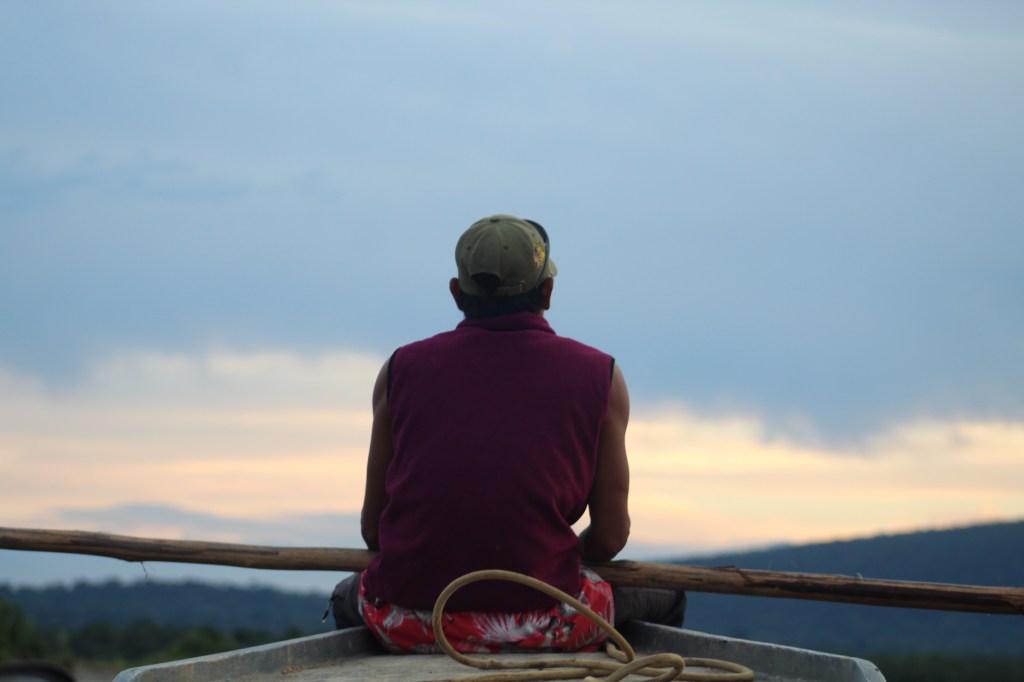
Alto Madre de Dios river. The foothills of the Andes can be seen in the distance.
The overarching point is that the narrow stabs at knowledge we take in the West fail to generate an ecological understanding on par with what we are so clearly capable of achieving. The most deeply rooted, ecologically-minded folks I know in the States come nowhere near this sort of environmental grasp. We still have large knowledge gaps, despite college educations tailored specifically to land or seascapes. I think it probably has to do with how we learn. My Matsigenka friends probably have never learned a plant or animal in their environment from a book. I’m assuming all was learned in the environment, while out on walks with parents and elders, whereas nearly every species I’m familiar with in my home environment of San Luis Obispo I got to know through the use of a guide book. Books are usually restricted to categories, be it a given plant family, habitat type, etc., but on a hike one is bound to traverse myriad naturally occurring categories, and therefore one’s learning on the fly is sure to be similarly trans-boundary. It only makes sense that on the same hike you would learn the species Artemisia californica (California Sagebrush) in tandem with the soil type that naturally calls it forth, for the soil and the plants occur together nearly as one out in the world, but in what textbook will you read about both soils and Artemisia? And in what textbook will you also learn that the spotted towhee adores Artemisia patches? These three things, the soil, the plant, and the bird are naturally co-occurring in San Luis Obispo coastal scrub, but are rarely, if ever, represented in the same book because publishers demand categorization—a theme must be chosen somewhere along the way. Books can teach us a lot about the natural world, but the way they represent information is in many ways alien to the natural systems they purport to speak of. This textualized knowledge upon which our society prides itself is a far cry from the world it represents in its pages. That’s not to put down books, it’s simply to remind us that we become like the medium we learn from. Bookish knowledge cultivates narrow, artificially categorized minds. Traditional Ecological Knowledge, when learned out in the world cultivates a mind as broad and intertwined as the world itself. To be a lugareño, to be of place, takes a good amount of the latter, in my opinion. It takes a lot of time being out on the landscape looking around, watching to see how different organisms interact with each other and with their environment. Passing that information on orally to your friends, students, or children while out in the coastal scrub is the critical next step. Little anecdotes about individual occurrences, or interactions between organisms, will, over time, start to melt down the boundaries we have constructed between natural types. Run that experiment for five or ten generations, and you start to get some real beautiful lugareños I’d imagine. Some things take time. I commend those trying to rebuild this process from scratch. It’s no easy task, but here in Amazonia I’ve seen what it looks like when built upon too many generations to count. And it is a thing of glory.
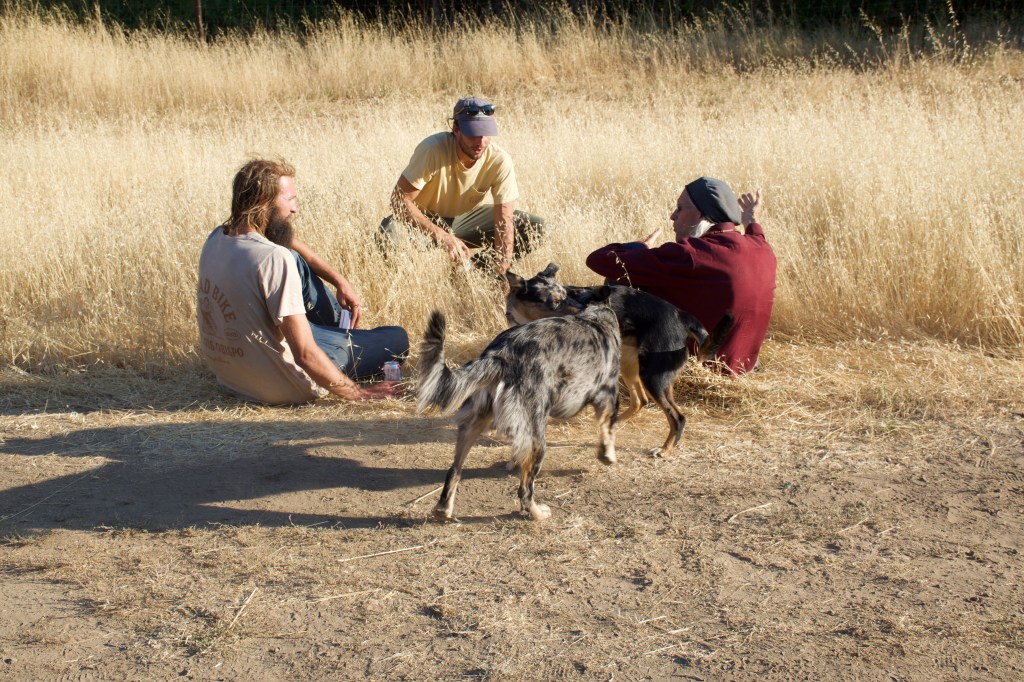
One must also remember that so far this has only been to speak of the ecological relation to a place—so many more varieties of relation exist. With enough time dedicated to a single place, the language, myth, songs, dances, poems, paintings, clothing—the whole cultural identity can start to flourish into something place-based, something de-globalized, something called forth by that perfect synthesis of creative minds and the landscape that enchants them. But we are getting ahead of ourselves. To my friends in California: it is certain to be a rocky start, but you must keep your head up. For now, learning to salvage road-kill deer for meat and hide is a good first step. Building little deer skull shrines and ornaments is probably a good sign. And standard, Kentucky bluegrass is more than acceptable for our musical starting point. Perhaps in a couple generations it will have taken on a Santa Lucian twang. I await that sound, yet to be born but certain to come someday—so long as we stay in that place long enough to allow our ears adjust to its sounds, and our eyes to its natural lighting, without the narrow beam of an overly bookish knowledge concentrating our gaze.
 PeterVanderBloomer.com