I’ve created a new website page, “Ecoacoustic Recordings,” where I’ve begun to upload environmental soundscapes that I’ve captured in various places with a field recorder. Hope you find these recordings as soothing as I do.
—Cheers, Peter
I’ve created a new website page, “Ecoacoustic Recordings,” where I’ve begun to upload environmental soundscapes that I’ve captured in various places with a field recorder. Hope you find these recordings as soothing as I do.
—Cheers, Peter
Hello readers. I am writing to inform you that I have made a Substack account, https://petervanderbloomer.substack.com/, and will from this point forward be writing first and foremost over there. I haven’t yet decided if I will keep this website up in the long run, but I do know that anything I write will first appear on my Substack newsletter “The Secular Pantheist,” so if you’re interested in following my work please consider subscribing by following the link provided above. There is no paywall for the time being.
-Cheers, Peter
It was a bit difficult to figure out who had the earrings I’d noticed earlier. Twenty or so Huaorani women stared at me, with a handful of wide-eyed kids peering out from between their legs and behind their hips. They all had various collections of handicrafts crammed into bags, and I’m pretty sure very few of them spoke much Spanish. They laughed and chatted away in their language ‘Wao Terero,’ while I perused some of their jewelry, satchels, headdresses, and other beautiful crafts all made entirely from forest products they themselves had gathered nearby. They told me that the Chambira Palm, Astrocaryum chambira, provided most of the fibers that they wove into everything from hammocks to bracelets to baskets. Wao Terero is a linguistic isolate, much like Esselen is believed to have been while it was still spoken by indigenous Californians in northern Big Sur. This means that it shows no linguistic similarities to any other language in the world—no one knows from which language family it might have evolved, or from where those who carry it on their tongue may have come. We can really only say that they have in all likelihood maintained a long isolation from nearby groups, or else evidence of such interactions would be found in terms and names exchanged between them and others. First contacted by the outside world only 70 years ago, today some of them sell handmade jewelry to an American ecologist at Yasuní Scientific Station in El Oriente—Ecuador’s Amazonian east. A land of extreme diversity, ever-wet forests traversed by numerous streams and rivers, and a place where two clans of the Huaorani still live fully removed from western civilization (by choice, I might add), hunting and gathering as they always have.

When I left the Amazon at the end of December last year, I remember being very unsure if I’d ever be returning. That last day, my Matsigenka friend Jhonatan and I were camped out at the most glorious of spots: a beach on the banks of the Alto Madre de Dios river, surrounded by lush rainforest vegetation, from which you could look west and see up past the numerous ridges of cloud forests all the way to snow-capped Andean peaks, gleaming in the distance. It was a juxtaposition of the sort one usually only expects from a dream. We sat and chatted over coffee, and I was surprisingly calm despite being at the end of such a life-altering half-year in the forest. I knew I was headed up into those mountains to catch New Year’s Eve in Cusco with some Peruvians I had met 6-months prior on my way in, and I knew that after that I would wander down into the south of Chile. Perhaps most importantly, I knew that after that I would head home. And at that point, despite my love for the people and places I’d come to know in South America, home was about the only thing that mattered to me anymore. That was Amazonia’s great lesson to me. I had seen people shaped by and anchored to their home environment in a way I’d never seen before and it has left an indelible mark on my psyche, on my own personal desires. Naturally, I wanted to apply that lesson in my own life—to make a homecoming of epic personal proportions, and never forget what I’d learned. Only, that homecoming came and went like a prairie fire and now I’m back in the place that had just told me to get lost, to go home.
Alan Watts used to say, in reference to the taking of psychedelics, “If you get the message, hang up the phone.” To that extent being back here is weird. I left California two years ago because I sensed that Amazonia had an important lesson to teach me. It did in fact, and I was a receptive pupil. It spoke to me in my dreams and mercifully gifted me with the revelation I just mentioned. Which begs the question, have I ignored the message and picked the phone back up just to be entranced by the alluring sound of the messenger’s voice, like fabled sailors drawn to the sirens? Or does Amazonia have more to teach me? I thought I already knew what I needed to know. I was calm that morning with Jhonatan on the riverbank staring up into the Andes because I felt myself in the earliest stages of enacting that greatest of lessons—I was making my (roundabout) way home to get there, sniff sagebrush, watch the 20,000-some sunsets (or whatever I was given), and stay put until my bones met the serpentine soil and gave up their phosphorous to the elemental maelstrom that comes after living.
In response to me explaining my predicament, a wise lady told me, “sometimes decisions get made for us. California will always be here.” Sometimes decisions get made for us. Her words still ring around my mind whenever I wonder what’s become of that message I had received like a hallowed text not long ago. It slid through my fingers like warm, silted water. Like the moon eclipsing the sun it made the briefest but most dramatic of impressions and then was lost to the brightening afternoon and the oddest of memories. We all chase meaning—I consider myself lucky to have found it and perhaps a moron for throwing it away. Then again, sometimes decisions get made for us. It is, after all, pretty wonderful to be back in this forest. And California will always be there, I suppose. But if I’m not there watching the golden eagles leap from their eyrie, seven feet on the wing and feathered to the talon, what good is it to know they still exist somewhere out there? I guess its like bait to draw me back again some day. And I guess I smile to know that Brian’s opal ceiling is so wildly adorned.
For whatever reason it has been important to me on my meditation journey to have a conceptual understanding of what it is I’m trying to do with meditation, even though meditation is ultimately a process of shedding conceptual layers. That may seem counterintuitive, but I’ve thought of it as like having a map that leads one to the brink of the great abyss. Maybe the right conceptual framing can help us move closer to the moment in which we finally drop those very concepts entirely. Perhaps I’m simply overly-conceptual. But perhaps I just need to know why it is, as I go to sit down on the cushion, that I’m sitting there at all. In order to get myself to the meditation cushion I have found that I need to ring the non-conceptual abyss with a conceptual scaffolding—a structure from which I might peer over the edge.
On that note, I had some sort of intellectual breakthrough yesterday with my understanding of what it is that the meditator is actually attempting to do in his/her shifting into pure awareness (or rigpa—the Tibetan term for ‘the ground of being’. Many terms could be used here. I will just use ‘pure awareness’). That is to say, I had a conceptual development of the process that ultimately leads to the elimination of concept itself. If you can embrace the paradox, perhaps this will be of assistance to your own personal meditation journeys.
The meditator ultimately is striving to cut out the conceptual framing of experience and to find union between subject and object—a union that this conceptual framing has been driven between like a wedge. Unio mystica, or mystical union, awaits its removal. I’d already known this for awhile, but yesterday I realized that there is no actual reason that I should feel my “self” to be located in my head other than for the coincidental arrangement of many of my sense organs all around it. There actually is no centralized place in space where the visual imagery or auditory stimuli all come together to be represented to the mind. I had always thought that these representations were being experienced by the mind over the shoulders, between the ears, and behind the eyes, and though this is true physically (i.e., these phenomena are in fact being processed there by the brain) it is actually not true experientially. That was just a deeply ingrained concept—the mind simply triangulates its own location by pinpointing the place over the shoulders, between the ears, and behind the eyes, but this experience of being situated there as a mind can collapse. Of course, as I’ve said, that is in fact where the brain sits, but as meditators we are interested in experiencing life as it is unfabricated (i.e. non-conceptually) as opposed to how our concepts tell us it is. And so, as a matter of experience sounds and sights are actually represented to the mind as occurring where the sensory objects themselves are located—that is to say, if one can dissolve the idea that their hearing of the world takes place in the head, they can find that instead they “hear” the world at all the various points in space where the world is making sound. The same goes for visual objects and all sensory phenomena. In that moment there is no longer a “listener”—there is only that which is heard, occurring where it actually occurs and not in the head. Awareness itself is externalized, and the barrier between body and environment breaks down. Sensations in the body lose their special status as “mine”. They come to feel no more or less attached to the observer than the engine drone of a passing airplane. In this unfabricated consciousness, phenomena exist autonomously as if free from a listener, a seer, a feeler—free from a meditator. This is the union of subject and object. When this occurs with all sensory phenomena, and when thoughts themselves are experienced in this manner as well, this is pure awareness as I currently understand it. When sustained, this is non-duality.

"She saw that all phenomena arose, abided, and fell away
she saw that the knowing of all this arose, abided, and fell away
then she knew there was nothing more than this
no ground, nothing to lean on stronger than the cane she held
nothing to lean upon at all, and no one leaning
and she opened the clenched fist in her mind and let go
and fell into the midst of everything."

-On the moment of enlightenment of the 19th century Japanese Zen nun Tejitsu,
from the text Women of the Way by Sallie Tisdale

Reading Carl Jung’s Man and His Symbols has done wonders for my dream world. It was like carrying a torch from the center of the brightly lit, conscious mind down to the precipice of the unconscious and holding that torch up to the void in order to illuminate the symbols rising up out of it. Symbols that had long been lost on me, or not remembered. I’m skeptical of much of Jung’s analysis of those symbols—it is in no way a ‘science’—but nothing has ever so deeply encouraged me to at least recognize the forms that arise therein, to look for patterns, and to at least try and grapple with their meanings. I think the attempt at analysis is the most important part. Every morning now begins with this fascinating puzzle of trying to understand the purely symbolic in a world not meant to handle it. Where I once had nothingness—a dim crawl out of blind sleep—I now have intimidating jaguars, talking eagles, and snakes of an ineffable holiness, among other things.
11/11/23, 05:45 a.m. — I am just now waking from a dream in which I found myself in the midst of an indigenous group as a witness to a rather extraordinary sacrament of theirs, though the setting was a planet other than Earth.
On this planet, there is some atmospheric oxygen but no naturally occurring wind. The creatures of this planet, seemingly more or less the same creatures that live on Earth, live perpetually near the bare minimum of their metabolic oxygen requirements.
I find myself in a vast sandy white plain with blindingly white skies, standing near the edge of a large burrow that had been dug into the ground. It is the burrow of a large boa constrictor around the same size as an anaconda, I judge, based off the width of the hole, though I never actually see the snake itself. There are people all around the hole praying or chanting. They have laid down offerings to the snake—beautiful, metallic gifts that completely cover the ground around the burrow. I don’t know what the gifts are, but they are beautiful things that glint dazzlingly blue and white in the sunlight. Somehow I know that the snake itself is a shimmering blue and white creature when seen in the bright light of this world. It is clear the snake is a deity figure to this society, perhaps the sole deity figure.
I am told that the windwalkers are coming, and without it being explained to me I understand their purpose. In this oxygen-depleted world, the inside of the burrow of the great snake is an uncomfortable, almost anaerobic environment, and so the worshippers began a tradition long ago of journeying on foot from many miles away over the desert sands and walking without pause to the burrow’s entrance. By their movement they create eddies of air in the otherwise stagnant sky that build upon themselves as the windwalkers converge like spokes on a wheel from all around, bringing oxygen rich gusts of wind with them in their wake. Once at the burrow these winds are somehow funneled down into its depths, essentially bringing the gift of breath, of rich air, to their deity curled up in its lair beneath the ground.
I think that Jung would have had fun with this one. He may have even described it as a “Great Dream,” a term he used for those dreams that are particularly rife with potential meaning and symbolism, rare dreams that leave the dreamer awestruck and the analyst perplexed. He definitely would have noted the mandala shape made by the overall arrangement of the parts of the dream, with the windwalkers converging from distant radii upon a central point. There would have been a lot to say about the symbolism of the snake itself, and the hole down into the ground where the snake resided. The overall dichotomy between the airless, dark, snake spirit underworld and the bright white upper world is also of some consequence. But the society worshipping the snake? Jung would have said that the individual worshippers each represented parts of my own psyche, but it’s interesting that they all behaved in unison because the psyche is normally represented in a very heterogenous (if not outright combative) way. Much of it eludes a deeper interpretation, at least for someone untrained in Jungian analysis like myself.
My favorite thing about the Jungian take on dreams is the belief that the symbols which arise come not from an individual’s unconscious creations, but from a deep ancestral past—the collective unconscious, as Jung called it. In Jung’s view, the archetype of the snake didn’t enter my mind when I first saw a snake as a child. It came along for the ride somehow, through countless generations, by some mechanism of information storage and transfer we can’t yet explain, nor disqualify. If Jung is right, the snake as an idea, as a symbol, within the human mind stretches way back into deep time—to a time in which my ancestors’ relations to snakes were far more intimate than mine are today. Today I know the snake only in passing. It is far from something that need occupy much of my thought—not so for those who sleep in open air huts and spend all day trekking through tall grasses. And so, if Jung is right, to spend time with one’s dreams is to tie a conceptual knot of sorts: to unite the present and the past, to recognize that the deep past is still very much alive within each of us.
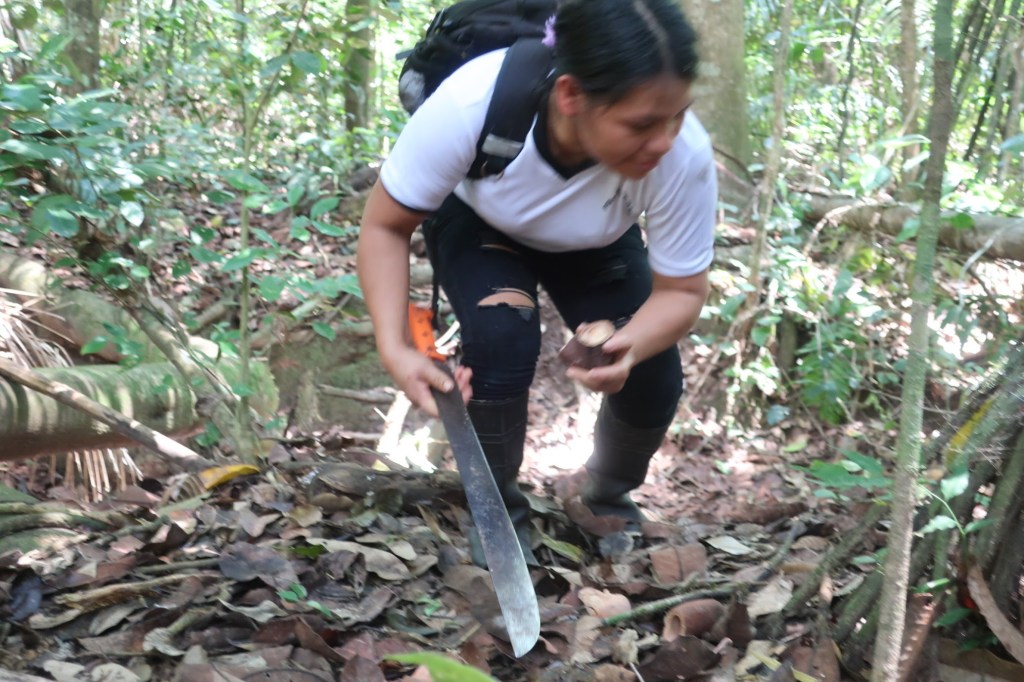
I haven’t quite figured out why I was drawn to Amazonia. Was it simply the understandable allure of lush, rainforest vegetation and its accompanying assortment of a diverse and spectacular fauna? Or was I looking to find something in Amazonia that was lost over a century ago in the lower 48 states—namely, intact indigenous societies as yet uncoupled from the global economy? Both of those things are certainly true, but the real motivation that pulled me down here feels different in some crucial way that I’m still working out. But perhaps most importantly, the deeper my mind has been drawn into this place the more poignantly I’ve come across signs pointing me home. This process actually began at the very beginning of my Latin American journey in the city of Monterrey in Mexico’s far northeast over a year ago now, but I wasn’t ready back then to interpret what I was seeing. Starting in Monterrey, and continuing in every city, town, village, and countryside between there and Perú, I’ve had the same conversation time and time again with taxi drivers, shoe shiners, restaurant workers, farmers—you name it.
Stranger: “¿De dónde vienes joven?” (Where are you coming from young man?)
Me: “De Chicago, en los Estados Unidos. Yo crecí alla. ” (From Chicago, in the U.S. I grew up there.)
Stranger: “Híjole. Ese es muy lejos de acá.” (Wow. That’s very far from here.)
Me: “Si. ¿Y tú, de dónde eres?” (Yeah. Where are you from?)
Stranger: “Soy de acá.” (I’m from here.)
Everybody, everywhere I’ve been, is always, and simply, “from here.” I’ve stopped even asking. In the U.S. this is a perfectly legitimate question, as we move and shuffle around like the brownian motion described by heated molecules. In Latin America, that question is a begging of the obvious, almost laughable. Everybody lives out their lives where they were born, where their parents reside, where their grandparents are buried, where they are recognized in the street—you get the point. It had never dawned on me before this trip that the thing we disparagingly call being a ‘townie’ in the U.S., i.e., someone who never leaves their hometown, is actually the way that most of the rest of the world simply lives out their lives. The fashion, amongst a large sector of the American populace, is to exude a sort of cosmopolitanism—to be worldly, through travel, through taking jobs on the other side of the country (or planet, for that matter). There is undoubtedly something to gain from travel, from living away from home. But in this questing for a spatial knowledge of the world, one sacrifices the temporal knowledge that comes from watching a single place and its people change over the course of time. After more than a year of travel now, I’m also beginning to question whether the traveler actually even gains spatial knowledge of the world by moving around it. To actually know a place, you kind of have to live there. For how long? I can’t say. But I can say that by maybe the four to five year mark in San Luis Obispo, I started to feel like I was sinking into the place. By year seven certain trailheads were starting to feel like long-time friends, certain streets held deep memory banks. Had I passed through San Luis “on a trip,” none of that could have been said. So what would I have added, spatially, to my knowledge of the world by visiting? In broader terms, what does travel actually give us? Certainly something, but we mustn’t forget that whatever is gained comes at the expense of time lost in whatever place you call home. To say the least, I’ve grown deeply skeptical of travel. But that in itself has been the great lesson. Without leaving home, I never would have learned what a fool’s errand it is. Or rather, how incredible it can be to resist cosmopolitanism—to devote oneself not to traveling across the Earth, but to experiencing a single place deeply through time. Amazonia is where that lesson was really brought home to me.
I now have a handful of friends who grew up in indigenous villages—villages that subsist entirely on hunting, gathering, and farming. This is the strongest case that exists for what we in America call being a ‘townie.’ A more benign term would be a ‘local.’ My favorite of all is the Spanish version for this, un lugareño, which is not quite a literal translation for ‘a local.’ Lugar means ‘place’ in Spanish, and therefore a lugareño/a is a man or woman ‘of (a given) place.’ In these indigenous folks, I found striking examples of what it means to be ‘of place.’ The extent to which they represent an intimate relation with their environment is hard to overstate.
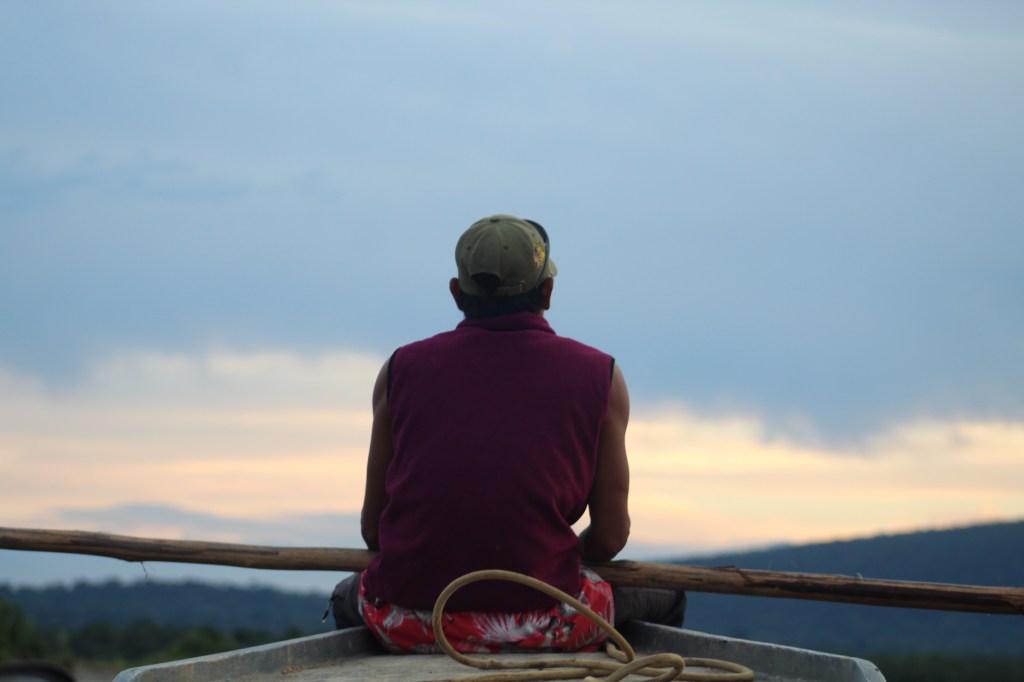
On an expedition about two months ago down towards Puerto Maldonado, I got to know a Matsigenka man named Jhonathan who grew up in one of the native communities located within Manú National Park. He served as one of the boat drivers for our journey, as well as a scientific aid for the data collection. To begin with, he knew the plants and animals of the region better than any of us “ecologists,” drawing into question what it was that we actually considered ourselves to be educated in. Science, even ecology, simply does not cultivate the broad scope of awareness that one develops through a lifetime living in a place. Science works through a highly constrained probing of a given system. It’s like walking at night through the forest with a flashlight, where one’s entire focus is restricted to a narrow beam of light. Clearly, the environmental education that life in a native community provides is of an entirely different type. Perhaps it’s more like allowing one’s eyes to adjust to the nighttime forest, and perceiving the environment as a whole, lit in soft moonlight. Safe to say, any and all lingering conceptions that I had of the superiority of science or scientists collapsed pretty quickly. In Amazonia, the boat drivers, without a degree to their name, are better ecologists than the best of the formally trained ones that come down here to study. And better by a large margin, as if we were not even playing the same game. The other day I was speaking with anthropologist Glenn Shepard jr. about this subject, and he said something along the lines of,
“You can find an ecologist who knows a given taxonomic group better than them [the indigenous folks], but you can’t find one who has an equal depth of knowledge across the ecological spectrum. For example, an ecologist will come down here to study, say, Malvaceae [a plant family] and they might be better able to distinguish between species in that family than anyone else. But ask them to do the same with say, Fabaceae [another plant family], and they will be totally out of their element. The Matsigenka, on the other hand, will be familiar with species in essentially every plant family in this forest, let alone the mammals, birds, insects, fish, etc.”
And you must also keep in mind that their knowledge is of course not limited to identification alone. They know how and where and when to catch each species of fish or game, which necessitates a thorough understanding of animal behavior, and then how to perfectly, and quickly, gut and clean and cook each one. They know in which logs at which stage of rot to find Suri, the popular beetle grub delicacy. They know which plants to use for body painting, to remedy snake bite, or to use to treat the atrocious tropical disease leishmaniasis. The list goes on. I had of course read these sorts of accounts of Traditional Ecological Knowledge, as it is now called in the states. But that term fails to capture so much of the beauty. This is more than knowledge. The very way in which my friend Jhonathan moves through the landscape is distinctly impressive. I watched him swim a net out into the Alto Madre de Dios river one night and tread water against the current for over half an hour before returning with a net full of fish. It was all done so effectively, so fluidly. It is more than knowledge that we are talking about here.
The overarching point is that the narrow stabs at knowledge we take in the West fail to generate an ecological understanding on par with what we are so clearly capable of achieving. The most deeply rooted, ecologically-minded folks I know in the States come nowhere near this sort of environmental grasp. We still have large knowledge gaps, despite college educations tailored specifically to land or seascapes. I think it probably has to do with how we learn. My Matsigenka friends probably have never learned a plant or animal in their environment from a book. I’m assuming all was learned in the environment, while out on walks with parents and elders, whereas nearly every species I’m familiar with in my home environment of San Luis Obispo I got to know through the use of a guide book. Books are usually restricted to categories, be it a given plant family, habitat type, etc., but on a hike one is bound to traverse myriad naturally occurring categories, and therefore one’s learning on the fly is sure to be similarly trans-boundary. It only makes sense that on the same hike you would learn the species Artemisia californica (California Sagebrush) in tandem with the soil type that naturally calls it forth, for the soil and the plants occur together nearly as one out in the world, but in what textbook will you read about both soils and Artemisia? And in what textbook will you also learn that the spotted towhee adores Artemisia patches? These three things, the soil, the plant, and the bird are naturally co-occurring in San Luis Obispo coastal scrub, but are rarely, if ever, represented in the same book because publishers demand categorization—a theme must be chosen somewhere along the way. Books can teach us a lot about the natural world, but the way they represent information is in many ways alien to the natural systems they purport to speak of. This textualized knowledge upon which our society prides itself is a far cry from the world it represents in its pages. That’s not to put down books, it’s simply to remind us that we become like the medium we learn from. Bookish knowledge cultivates narrow, artificially categorized minds. Traditional Ecological Knowledge, when learned out in the world cultivates a mind as broad and intertwined as the world itself. To be a lugareño, to be of place, takes a good amount of the latter, in my opinion. It takes a lot of time being out on the landscape looking around, watching to see how different organisms interact with each other and with their environment. Passing that information on orally to your friends, students, or children while out in the coastal scrub is the critical next step. Little anecdotes about individual occurrences, or interactions between organisms, will, over time, start to melt down the boundaries we have constructed between natural types. Run that experiment for five or ten generations, and you start to get some real beautiful lugareños I’d imagine. Some things take time. I commend those trying to rebuild this process from scratch. It’s no easy task, but here in Amazonia I’ve seen what it looks like when built upon too many generations to count. And it is a thing of glory.
One must also remember that so far this has only been to speak of the ecological relation to a place—so many more varieties of relation exist. With enough time dedicated to a single place, the language, myth, songs, dances, poems, paintings, clothing—the whole cultural identity can start to flourish into something place-based, something de-globalized, something called forth by that perfect synthesis of creative minds and the landscape that enchants them. But we are getting ahead of ourselves. To my friends in California: it is certain to be a rocky start, but you must keep your head up. For now, learning to salvage road-kill deer for meat and hide is a good first step. Building little deer skull shrines and ornaments is probably a good sign. And standard, Kentucky bluegrass is more than acceptable for our musical starting point. Perhaps in a couple generations it will have taken on a Santa Lucian twang. I await that sound, yet to be born but certain to come someday—so long as we stay in that place long enough to allow our ears adjust to its sounds, and our eyes to its natural lighting, without the narrow beam of an overly bookish knowledge concentrating our gaze.
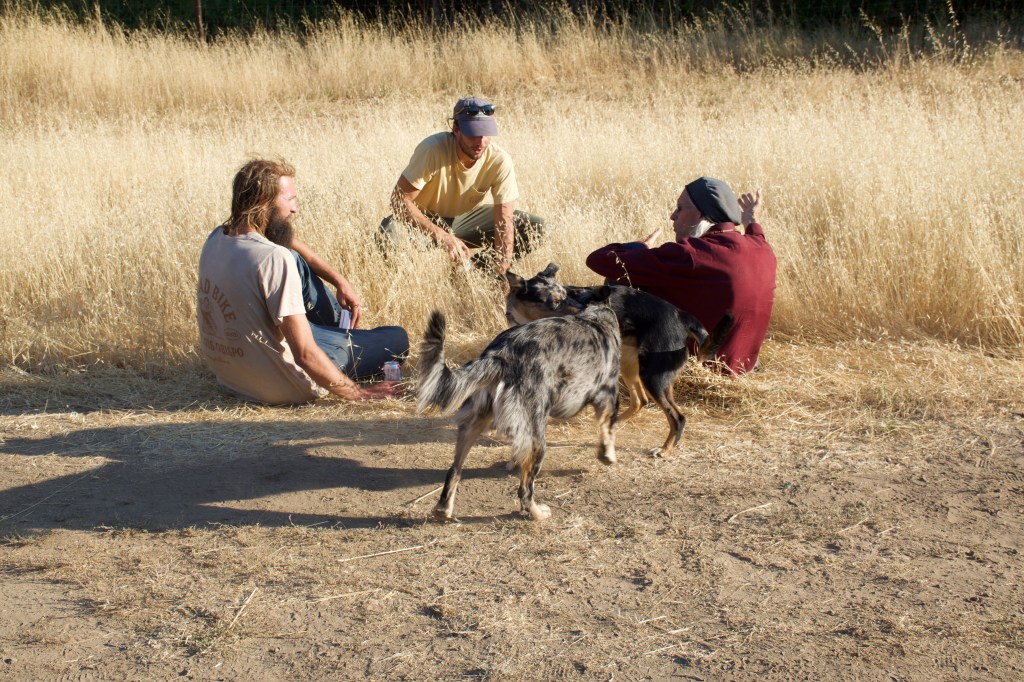

Of the many debts of gratitude I owe Eric Greening, exposing me to Robinson Jeffers in the early fall of 2017 is certainly amongst them. In our first conversation together on Cal Poly’s Dexter Lawn one September day he recited Jeffers’ “Vulture” to me from memory. In that moment a great friendship and a favorite poet simultaneously entered my life. I was telling some Peruvian friends about this poem last night after the joke was made that, based off of how we were all smelling after a day of vigorous forest trekking, if one of us were to lay out on the riverbank long enough, certainly a king vulture would come down to investigate. I translated this poem in order to share it with them. Any Spanish speaking readers out there are invited to comment on the quality of the translation. “Encielo” was naturally the point of friction, as it is a made up word to stand for Jeffers’ equally made up, but wonderful, “enskyment.”

I must have met a thousand folks in the course of the last 14 months since I left the central coast of California. That thousand includes some real gems, and some real interesting, unique people living really interesting and unique lives across Latin America. It includes Mexican off-the-gridders, Belizean beach dwellers, Guatemalan old-school urbanites, Costa Rican Techies, Panamanian fisherman, Puerto Rican cowboys, Andean farmers, and indigenous Amazonian rivermen, to name a handful. The stories are expansive and the lives near unfathomable to a young man like me fledged from a suburban Chicago nest. But despite this all, this deep exposure to the broader world, something about the friends I left back home is clearly irreplaceable. On the road, after a thousand folks and ten-thousand handshakes, I’ve come nowhere near replacing them with latin versions. My friends have rather, in my mind, been distilled down into archetypes of sorts——essential forms of the human spirit, irreplaceable by anything I’ve stumbled across in the rich flow of time and sensation over the last year. Maybe it’s because we grew up together in that metamorphic San Luis period of our lives. We all met at 18 or so, pseudo-adults, and then flocked into strange herds, threw strange, wild art-shows, backpacked deep into the backcountry, and intoxicated ourselves together in the heat of the party or in the quiet forest or on the cliffs above the ocean——as if hell bent on a sort of collective self-discovery. Whatever that process was, and however we knew how to perform it (it was as if unconsciously directed), it was beautiful and you all became my angels, godsends into a life whose first 18 years were spent in a sort of solitary headspace.
Point is, I haven’t met a single Beats on this journey——no latin version of that wonderful guy, nor a single Brian, Gurney, Dan, Eric, Emma, Jamie, Stone, etc. And of course no latin version of Dave (thank god——one being plenty). I think when I left I already knew the irreplaceability of the pack, and that was why the tears had flowed that day (and a few nights since) so profusely. Something as yet undefined pulled me away, but the pack already felt then, and even more so now, as having been set in stone by the random course of life, the Cheerio Effect of like-spirits flocking together in the great milk bowl. To attempt to reinvent that elsewhere would be sacrilege——sin, as far as I use that term in my life.
How did I get so damn lucky?

In attempting to define what constitutes a wilderness area Aldo Leopold once wrote, “By ‘wilderness’ I mean a continuous stretch of country preserved in its natural state, open to lawful hunting and fishing, big enough to absorb a two weeks’ pack trip, and kept devoid of roads, artificial trails, cottages or works of man.” It’s an O.K. definition in my opinion. I loved it at the time——in fact I first came across those words while reading from A Sand County Almanac on a pack trip of my own in the Sierras during college. But I’ve since come to think otherwise. First off, I disagree that trails make a place “un-wild.” Many species make and use trails. The careful, trained eye of a naturalist has no trouble seeing that California chaparral is one big maze of grey fox, skunk, and rabbit trails. In Amazonia, the sheer size of the adult tapir necessitates trails through the understory, and they cross rivers at the same locations time and time again, entering from and disappearing on the other side back into an established trail network all their own. And so I don’t see why human trails should be viewed as categorically distinct. But the main reason I write today is because this definition of Leopold’s came to mind when I was reflecting on the size of Amazonian wilderness. The ability to absorb a two-weeks’ pack trip perhaps suffices for wilderness in the lower 48 states. But I am currently in a forest that is (still) large enough to absorb the endless wanderings of entire cultures——to absorb the religion and song, the gardens, the childbirth, the burials, the migrations, the sacred spots, and the perpetuity of entire human languages as they play out and evolve beneath the endless canopy and up and down the myriad forest streams and rivers. Now I say “(still)” because this fact is nearing its end. The encroach of the global economy is hemming this all in to a smaller and smaller area from all sides. I’m sure Leopold’s definition will always suffice for certain areas of South America, no matter how far deforestation progresses. A two-weeks’ pack trip through tropical rainforest would only require a pretty small parcel of land relative to what exists here to this day. But there’s something else that needs defining. If land sufficient to absorb a two-weeks’ pack trip is “wilderness”, what the hell is this thing I’ve stumbled upon down here in Peru? Pack trips for us westerners come and go. But the hunter-gatherer-farmer of Amazonia is on a pack trip of some one-hundred thousand years that began in the African Rift Valley, arced up through the Bering Straight (by foot or animal-hide kayak) and came all the way down to land in the great tropical forests of South America. The greatest pack trip in the history of our species continues to the current day in the remaining parcels of this world’s roadless forests. And the irony is that these people by and large don’t use packs. It’s a mostly pack-less pack trip. The men move from site to site with their bows, arrows, or blowguns in hand, and the women will carry a child too young to walk in a sling upon their backs, but there is little to carry when the forest is your pantry, your library, your church, your medicine cabinet, your workshop, and your hardware store. I only call it a pack trip to tie these cultures in with the closest experience to this that any of us westerners have had. Pack trips have been some of the greatest experiences of my life. To imagine one that would begin for me one day and never end, not in my life or in the lives of my children or grandchildren, is to come the closest I can come to imagining the life of the (mostly) nomadic hunter-gatherer-farmer. But you’d also have to imagine the pack that you started with dissolving over time. You’d have to imagine its contents becoming increasingly unimportant as you learned to fabricate them yourself. You’d have to imagine the clothes that you started off with eventually failing over time, and, at least in tropical rainforest, quickly being seen as more of a nuisance than a blessing. The human skin, naked to the forest, sheds water and heat and fungus more or less perfectly. And so you began with a pack and swishy tech-pants but are eventually naked with only a couple vital belongings carried by hand from place to place. That being said, all of us, even the greatest of botanists, lack the medicinal and tactical knowledge of the forest to actually initiate this endless pack trip from scratch. And that’s the great tragedy of it all: it was a pack trip that succeeded only in its continuity. Only in its slow transition from one ecotone into the next. And only in its great and precious storehouse of knowledge passed down successfully through the generations. And let us also remember that there was no single day in the Rift Valley in which this all began. We made the epochs-long transition from one form into the next, and by the time we could have properly been called Homo sapiens we already had a cognitive storehouse of environmental knowledge. It comes to us from the deep past and would take lifetimes to recover.
I fear most of all that there is no re-starting the nomadic lifestyle (or pack trip as I’ve been calling it for literary sake) once it ceases. Once the thread is snipped, the culture falls from the great ceiling of its ancestry to the floor upon which the modern world now dwells, and I’m unsure how, even if it wanted, a group would successfully turn its back on the global, hyper-specialized order, and walk back into the brush. At least I’ve not found any examples of such an event taking place. Perhaps the maroons of Suriname represent the closest case study to the situation I’m failing to imagine. However, its believed that the maroons (escaped African slaves that fled into Caribbean and Amazonian forests and successfully founded their own forest-dwelling cultures) joined with already existing indigenous groups in many cases, so those indigenous groups would represent the continuity of the vital thread I have just described——the continuity of the environmental knowledge required to allow culture to flourish independent of the global economy. And so I remain unconvinced that the nomadic existence can be reinvented by the lost and disillusioned children of the global order. I await an example that proves me wrong and thus could be a source of hope.
All of this is to say that I can’t imagine a greater cause than protecting not only the forests, but also the cultures within them that still represent humanity’s initial relation to the Earth. I want the great pack trip to continue alongside the strange experiment currently being run by modern civilization. I am skeptical of modernity’s prospects for longevity, and think that it is therefore vital we allow the 100-200 groups still remaining in an un-contacted state to continue weaving the vital thread of our initial relation, generation by generation, on into perpetuity as not only cultures equally viable and rich (and therefore deserving) as our own but also as a control group to the western experiment. These groups have proven the longevity of their ways, and we in the west have not. Every decade for us is a dance upon the brink of destruction and our society, within a single human lifespan, becomes unrecognizable to those on their deathbed who remember it from their childhood. This is a crazy game being played by the 8 billion of us involved, and there is not only a moral argument to be made for the protection of the remaining un-contacted groups, but also an existential one. If the global order fails and all descends into chaos, it won’t be the redneck doomsday preppers who serve as the seeds of our species’ recolonization of the globe. The preppers are only prepping for a few decades, and soon their bullets will all have been shot and their rice eaten and they too will perish, for in their prepping they opted for stores of grain and guns instead of field guides. Rather, the seeds of our species’ recolonization will be those still in contact with the only environmental relation that has every proved itself viable in the longterm.
The more I think about it, the more I think there is not actually a term that works for these areas that contain the wandering tribes. “Wilderness” works for those who live outside of it and see it as a patch of earth to be entered and enjoyed, and then left. But if your culture roams within one of these zones to which I am namelessly referring, “wilderness” is simply the world in which you inhabit, for there is no non-wilderness to which your world can be compared. For my own sake, and for lack of any better term, I’ve been (delightedly) thinking of these forests as simply the place of the endless pack trip.

I reflect today on all the things I’ve given up in the pursuit of my life’s deepest calling. I see the faces of friends, teary-eyed, as I hug them goodbye in a California meadow after a night we all spent beneath the stars, talking around a camp fire and eating wild rabbit stew. I still wonder often how and why I let a dream lodged deep in my mind pull me away from the beautiful reality of their faces——their conversations. Some yearnings are apparently like that. A dream, it seems, can be more tightly anchored to your sense of meaning than the entirety of the loved ones and the environment that surrounds you. It was a question unanswered——a fate I had managed to push away, for I hadn’t been strong enough to embrace it.
There is this vision from my youth of being seated in a long, thin dugout canoe, as it ploughs it’s way upriver. The forest edges envelop the banks, and the cacophony of all the forest’s unseen residents resound over the outboard engine’s drone. I must have seen it somewhere on television, probably National Geographic, at a very young age, but my mind claimed the experience as it’s own. I saw and still see the vision from the inside as if it was my memory——a memory of mine that I lost somewhere a while back, and picked up again from the T.V. And it has never left me. But I don’t run lightly into the realization of the dream. Life is far more nuanced. I still carry the old life of mine I killed in order to birth this new relation to primeval Earth. And it is a heavy burden.
My heart is heavy with the distance between it and its old companions, and yet my heart is light, in openness to radical transformation. And I don’t mean radical transformation of the self, but of the life—-of different modes of attention, never before realized. Of a different context with the non-human. The self? I hope to leave it behind, perhaps in the forest somewhere, in the last place where self-referential thinking held any significant grip on my attention. For life is limited, and attention a finite resource within that already limited span of time we’re given. I guess that’s part of the reason I left. In community our mind spends some of its time wondering what worth it, the self, has in concert with the others. Is it a significant contributor to the dynamic spirit of this or that cluster of human lives? The forest, notably, cares not for the human. The forest will give the human its richly oxygenated air, or a taste of its fecund fruiting, but the forest will also parasitize the human, predate upon the human. The forest, ultimately, will treat the human with complete indifference. And for those looking to be absorbed into something greater than themselves, greater than even the strongest human community, that can be a strange blessing. I’m unsure if it can be sustained in the long-term, but I intend to find out. It would be like taking the beautiful refracting prism of the human mind, shattering it, and dispersing it up amongst the branches, across the soil, and behind the million peering eyes.
A fantastic experience is having one of your long-held dualities collapse before your eyes, forcing everything in your world to be reorganized internally. Where water and oil once swirled around each other without the faintest trace of mixing, a duality collapsing reformats contrasting elements into a seamless oneness.
I had this experience last month. I was sitting on a break wall, on Panamá’s southern coast, looking east towards some high-rise condos. Behind them, a scrubby looking tropical-moist forest cloaked a coastal range in a greenish-bronze hue. The high-rise condos were brilliantly white like most buildings in the tropics, built to reflect the persistent heat. It was a bright, early dusk. A few lights shone from the condominium windows, but enough color was still left in the scene to starkly contrast the white monolithic towers with the greenish-bronze mountain backdrop. I was meditating, or trying at least, until an epiphany of sorts rippled across my mind, and the mindfulness session returned to thinking. But the thinking was well worth it this time.
As I stared at these buildings something fundamental about my normal, everyday perception was altered. They ceased being crude disruptions of the surrounding environment, as human civilization normally appears to me. Without the slightest alteration to their physical appearance, this cluster of towers changed radically in terms of how I was categorizing it. The towers became the natural constructions of a species, and I saw them as I would see a bee hive or a colony of coral. The fact that they were geometrically perfect, unlike all of their surroundings (with the exception of the flatness of the ocean surface) did nothing to disrupt the seamlessness of the natural picture, for the honeycomb within a hive is perfectly hexagonal. The fact that they were starting to glow from within similarly failed to interrupt their fusion with all things Earthen, for fireflies light up many a forest and bioluminescent tides sweep countless coastlines. The fact that I knew them to be highly engineered similarly had its natural aspect, for I saw beneath the vision the great constructions of beavers, ants, wasps, and termites. It was all natural. Animals crawl across this globe, and some do so by swimming or walking, whereas others hitchhike on fur or flesh. And some ride upon the chemistry of internal-combustion engines. It all is one great chemical storm——dynamic components inseparably a part of one totality. Animals built those towers gleaming there in the dusk——those white perfect prisms. To the bee the hexagon is the most efficient way to store honey and pollen. To the beaver damming a lake is better done with rounded edges, and yet to humans geometric designs dominate. For us, it’s simply easiest to replicate straight edges, easiest en masse to fabricate parts for rectangular rooms, and more efficient to furnish. Animals built those towers gleaming there in the dusk as they’ve built structures for eons. More lights flicked on in the small square windows as the dusk further settled, emblematic of the lives being lived within them. And the towers looked perfect there, as did the trees on the hillside behind them. It struck me that the only reason the towers had appeared strange to me for a lifetime was that I was seeing them from within the species that built them. The “artificial”, therefore, is but a synonym for “ours.” Perhaps to the beaver all is natural——one seamless world of plant and animal forms, until it happens upon a dam of its own kind. It knows (perhaps only intuitively) something about the effort and design that went in this structure. It can understand it from within. It has chanced upon an artificial object.
There are obvious differences between how Homo sapiens constructs its environment as compared to other species. But it was a real blessing, for a few minutes, to have seen those differences as differences of degree, and not of kind. We are different than other species, but we are still a species. A species of animal erecting towers, for that is simply how we’ve been driven to live.
Of course, it’s good to have that duality in place when necessary. Our species, though certainly one animal type among others, is in a state of unbridled expansion and influence. And I certainly don’t mean to insist that we should sit back and accept this human-induced global change as natural and therefore acceptable. But whether our expansion and influence is a good or bad thing is ultimately going to be judged and decided only by us. And that’s an interesting predicament to find oneself in. Ultimately, I can only hope we are a natural kind that, instead of total domination, prefers to have itself living in concert with a diverse assemblage of other kinds. We were given both the technological prowess to dominate the world as well as a sufficient dose of romanticism to lament that very same domination. And it’s more than romanticism. We will cripple ourselves in making the globe completely “artificial.” But all educated people know that. I write this to try and catalyze a (temporary) collapse in the natural/human dichotomy in the reader. It may prove a useful frame. It’s at least enjoyable, and at most critically necessary to see ourselves as strange animals from time to time. To see everything from within.

The human mind is the eye of a needle through which the universe is forced to experience itself. All of sensory experience lies both upstream and downstream of this point in space——this delicate construction. The normal, waking mind tries to filter all things through its feeble frame. All things of course do not fit through——almost all things, in fact, go unobserved. And so it accounts for the leftovers by way of fabrication. It fabricates an illusory world, it takes the fleeting rivulet of sensory stimulation that passes through it, and uses concepts as a bridge to all the other things beyond. It honestly believes that as but a needle’s eye, dipped into the stream of life, it is able to speak for the stream as a whole. What we call intelligent minds are those who form the most convincing concepts to account for the rest of the raging flow. The mind of the experienced meditator, however, pulls the needle out of the stream of life. Upstream and downstream of this point converge, and the mind ceases to force anything through itself. The feeble frame dissolves: the mind and the stream of life become synonymous. This is the unfabricated world. This is the “ground” of all things that the Tibetans speak of. Knowledge of the ground is known as “Rigpa” in Tibetan. To be in a state of Rigpa is to be in a state where the universe simply flows non-conceptualized. The self too dissolves, for the separate identification of individuality is but a concept. When the self dissolves, the body of course remains. The body rests there, breathing slowly, while the world goes about its course. This, and nothing else, is nature.

I think about my own death every day, multiple times. This thinking comes not from fear——I have purposefully cultivated this attention to the matter. However, to love death itself would be a sickness in my eyes. This essay is therefore not to be taken as an ode to death itself, but rather as an ode to the concept of death.
All our lives we live knowing that something called death sits on some inevitable, (hopefully) distant horizon. Some (the non-religious) see it as an end, while others see it as a gateway. Essentially every major religion on Earth is a system of thought built around denying death its finality——a conceptual way to bypass earthly fate. The three Abrahamic faiths have an afterlife, heaven or hell depending; the Buddhists and the Hindus have reincarnation. Those five religious persuasions represent the vast majority of the world’s population. I argue that those who see death as but a gateway miss out on life’s most important insight.
And that is coming from someone who was once deeply entrenched within the religious view of things. I grew up catholic, and was in fact devout——by far the most religiously devout of my family, and perhaps of the whole Sunday school I attended with my peers. I had a personal relationship with my God, I prayed often on my own juvenile accord, and I was firmly oriented within the eternal conception of life that the Catholic church espouses. I call it an eternal conception because in the Abrahamic framing of things after we “die” we pass on to either a blissful or tortuous everlasting life. Regardless of its quality, conscious experience after death is taken as a given, and although far different than the life we lived here on Earth, it is more or less a continuation of the life of the mind on into eternity. The lights of consciousness don’t falter, but shine forth upon the dim recesses of hell or the sprawling pastures of paradise. This perpetuation of mind is unsurprisingly the default position that the world’s religions have settled upon. Aptly called by Marx “the opiate of the masses,” a successful religion must answer confidently to life’s tragic riddle, and remove from view the hardest pill life gives us to swallow. Plenty of wisdom has come down to us from this world’s scriptures, but the core eternal framing they nearly all share is an easy, rather than wise take on life. That we live on forever in some form is a message suitable perhaps for young children, but far from appropriate for adult minds. This is not to say that I think accepting death is easy, or that I myself have truly done it the ultimate justice it deserves. In fact I’m inclined to doubt that one can ever truly embrace the idea of their own inevitable demise. I just know that we can work productively towards embracing it, so as to avoid living in delusion. And the idea of death is powerful beyond belief, for those willing to confront it. It’s ultimately a kind of sorcery, on account of how deeply it can revolutionize one’s everyday experience. But like all powerful things, its potency is a double-edged sword.
I was somewhere between 15 and 17 when I lost my faith in God. It was a gradual process, and it wasn’t able to occur until I had the appropriate philosophical faculties in place in order to fill the void that a loss of faith leaves behind. At some point thereafter, actually quite a while after I’d become agnostic with my thinking, the most important insight of my life took place. Around this time, during the spring of my sophomore year of college, I was undergoing the largest intellectual metamorphosis I’ve experienced, before or since. The shift in worldview which took place was so rapid and so profound that I have the distinct impression I essentially became truly conscious, and truly myself, for the first time then——right around my 20th birthday. It’s hard for me now to even really know who I was or what I had spent the first 20 years of my life thinking about, the change appears so drastic in retrospect. Why this all came about is hard to say, but its clear that the environment I was raised in was not conducive to the formation of my true personality, and so it took a year or so of living on my own far from home, trying certain drugs, meeting interesting thinkers, studying philosophy, and reading a few truly formative books for the authentic version of myself to become unbound from its developmental strictures. I imagine many people experience something of this sort around that time in their lives. Anyways, that’s the background I deemed necessary to explain the insight——as I said, the most important insight of my life. I don’t remember the day, location, or nature of the moment itself, I just remember the mental landscape and how drastically and vividly it all shattered, and then pieced itself back together into a far vaster expanse. The intensity of that shattering still resonates in the background of my every moment——at least the moments when I’m clear and quiet enough to notice it.
What happened was as follows. Leading up to this point, although I had already internally renounced the Abrahamic framing of “life -> afterlife” for all the obvious reasons, my mind hadn’t yet truly formed its own replacement for this model. Some lingering eternal sentiment was still left in the hollow space that the Abrahamic model had excavated within my mind at a young, impressionable age. I had already denied god, but in this moment of revelation, the true repercussions of denying the other main component of the Catholic package, namely the afterlife, came bearing down on me with all the pain and blessings that such a denial, once fully embraced, logically entails.
The story in the fewest possible words is that a denial of the afterlife is simultaneously an intense affirmation of life. In a single moment I went from seeing a human lifetime as being but an interesting prelude to some mysterious next chapter to seeing a human lifetime for what it really is untethered from the eternal timeline, with all expectation of an afterlife dashed. And when that eternal frame is removed from our conception of life, we are left with no choice but to develop an intense religious awe for being alive in this world.
For those who find it hard to imagine how consciousness could possibly cease to be, just think back to your earliest memories. They appear like stepping stones in a void, that gradually become more and more prevalent until uniting into a constant stream of conscious experience. Our first memories appear out of nowhere, like the first few stars to show up in the dusk sky. We stepped into life out of nothingness; why is it so hard to imagine that we will someday fuse back into it? Like invisible bookends propping up the collection of life’s moments, nothingness surrounds life as far as we can tell when being intellectually honest. Life is like a blinking open into experience out of a perfect nothingness, and all the scenes of our sacred time here flash before that open eye staring out into space, until some day the great lid slams shut, never again to open. How can one possibly see life for what it is if they live under the spell of the idea that consciousness is granted to us for all time? The greatest error one can make while living their single, fleeting life is to take for granted the gift of conscious experience. If we acknowledge death as impending and final, which I grant is no easy task, only then I believe can we see the true immaculate beauty of having been here at all. Life is not ours to toil in forever. The loved ones we shared this world with are not ours to hold forever. But what a miracle in the ephemeral blinking open into life, before nothingness again takes hold, that we got to look around and craft meaning with other fleeting passengers rocketing through a lifetime that none of us asked to be given.
For all those I’ve been blessed with knowing: there is nothing more difficult for me than acknowledging that you are not mine to cherish forever. There is nothing more difficult than truly believing that I will never again get to hold those that I’ve lost. But despite the difficulty of living a life under the crushing weight of those beliefs, I can say with confidence that I never knew how to truly love another human before I held this fatal framing of our existence. It was so easy to be frustrated with my parents when I was a child, for I thought these were minds with whom I was to exist alongside forever. Knowing now that our time together on this Earth may come to an end any day, the way I think of them has been radically transformed. What a gift to have had such loving parents in this one lifetime. What a gift to have had such magnificent, interesting friends. My love for everyone in my life blossomed into full form only once I dropped the eternal framing, and came to see them all as fleeting passengers through life, flung up out of nothingness into somethingness, only to plunge back into the void again some day. To my fellow humans: what a strange gift its been to have crossed paths in such an inexplicable world. I didn’t ask to come into being, but it’s been glorious to have been here alongside you all, albeit only briefly. I certainly won’t be asking to leave when my time comes, but then again, I won’t be expecting to stick around either.
As I say in this essay’s title, in no way do I find death itself beautiful. I find it horrible——horrible beyond belief. It’s simply unspeakably horrible that all those I’ve known, all the thoughts I’ve enjoyed, and all the places I’ve come to love will dissolve for me some day with the rotting away of my brain. But I’m ultimately grateful to have found not peace but some sort of tenuous and painful acceptance of this process. I grapple with it every day. It hurts a good deal and has made me far more anxious about the loss of my own life, or that of my loved ones, compared to back when I thought we all were going to be here forever in some form. But I can say with certainty, through the use of a kind of dark sorcery, that I have come much more strongly into life by affirming the finality of death and denying the eternal framing of our time here. By my conception, life is not a ray of light starting at some natal point and extending on forever——a gift never to be revoked. It is instead more like a miraculous net of pearls floating in the void, intertwining amongst itself, with each conscious mind as one of the insane points in space that happen for a period of time to be experiencing the gift of life. And the whole thing is scintillating like stars do when low in the sky——scintillating as minds are brought forth to glow brightly for a flash before fading back seamlessly into the darkness.
I will keep this one short. I had the opportunity to observe a mating pair of Turquoise-browed Motmots foraging together yesterday in a defoliated Tropical-Dry forest aside Costa Rica’s Pacific coast. It was incredible, and may be the most ornate and beautiful bird I’ve ever seen. The Vermillion flycatcher that I saw in Oaxaca back in January was a close second. Anyways, as I continued again on my way after being spellbound by these magnificent birds for awhile, I had the thought that my ability to even see those birds for what they are has been shaped largely by my meditation practice. When I watch them I’m not fixated on the particulars——an organic blending occurs if I’m in a clear state of mind, where boundaries blur and everything takes on a higher resolution than everyday appearances. Meditation erodes the very constructs that the scientist works so diligently to build within his or her own mind, and takes to be sacred. If one goes down the scientific path with their career (and I’m particularly referring to a career in the biological sciences) and they do not simultaneously practice meditation, I feel that they are at risk of only being able to perceive the world through a lens that others have created and polished over the centuries. The meditator on the other hand is able to forever keep ajar the gates of awe which science, when unchecked, can clamp shut. The career scientist looks at the world from the perspective of an adult within his science, whereas the scientifically informed meditator maintains the ability to look at the world from the perspective of an infant within the universe——a universe far greater than understanding can ever truly penetrate——free of paradigm. That is at least the hope. The sciences can give so much to us, but we must never forget that they can also take away. With the correct practice, however, I believe we can keep the best from both methods of inquiry.


My first voyage at sea lies just ahead of me. We sail out tomorrow from the El Salvadoran coast straight across to Costa Rica. For four days now we’ve been readying the boat, and relaxing, waiting for the winds to settle a bit off the coast of Nicaragua. The other day I ran to the Pacific Ocean from our mooring on the Jaltepeque Estuary——this was my first time seeing the Pacific since being on the Oregon coast back in August of last year. My whole trip so far has been through the central highlands and along the Caribbean coast of Latin America, never venturing far enough west to greet her. And so coming back to the Pacific again felt like the turning over of some sort of psychic calendar, a return of sorts and yet unfamiliar, for here the water is warm and the beach opens up to the south. The path of the sun is more or less directly overhead the coastline.
Growing up in Chicago, I didn’t see the ocean for my first time until I was 14 years old, since all three coasts (the Gulf, the Atlantic, and the Pacific) are quite a journey from the continent’s interior. It’s therefore strange to be funneling down the isthmus of Central America, where a bus ride of only about 10 hours can take one from the Caribbean coast of Honduras to the Pacific coast of El Salvador——a distance that will only continue to shrink as I head further south.
Once my short little run had brought me to the beach, after swimming for a bit I sat down to pray, or meditate——the meanings of those two acts have been converging for me as of late——with a warm green sea in front of me to the south, and to my north the enigmatic Volcán San Vicente lofting up out of the haze of burning fields of sugarcane (which once burnt down to the stalk, men will labor to harvest under the oppressive Salvadoran heat for US $7.50 a day). And how cruel the random fates life deals out to the men and women it brings into this world: their burning fields and sweat-soaked brows making mystical my leisurely gaze of San Vicente’s high, rocky flanks.
I burst into tears, clearly a release that had been waiting to come until I was alone again in nature——a circumstance that has been surprisingly rare for me on this trip. The afternoon sun beat down on my skin. This is probably the tannest I’ve ever been, having skipped my first winter. I listened to the ocean with eyes closed for a while——could sense Vicente silently posturing upwards at my back. For some reason, behind closed eyes, I saw manta rays gliding through rich plankton seas, sieving the loaded water. I thought about how if evolution were to begin again from scratch on Earth, it seems almost certain that plankton (or something functionally identical) would again be selected from out the random chemical fervor, rising above the the less-effective alternative patterns of arrangement to become “locked-in” for another couple billion years of breathing oxygen into the world’s oceans. That niche of suspended oceanic photosynthesis seems destined to be filled time and time again. To imagine life trying to begin again without plankton in the picture seems akin to attempting to make a triangle out of just two sides. And of course, other planktonic organisms would arise to consume the photosynthesizers. It therefore seems almost preordained that eventually something like manta rays would arise to consume the whole proteinaceous mess, and on and on. Is it the manta ray itself that I love so dearly, or the seeming will of the world that would call such a pattern forth, time and time again?
Eventually I became struck with the thought that what I love most is not in fact the individual organic creations this world has produced, but rather the fact that these things were (and always will be) willed into creation by the simple existence of natural law——what I truly love is not the life that exists but that life exists——that life is simply what happens when what we’ve come to call “laws” are left to their own devices. These laws are not themselves perceptible, but their impact is clearly inscribed across the forms of the empirical world. They don’t exist in themselves perhaps, but reveal themselves like the hands of an invisible sculptor through their works alone.
Is a love for natural law a love of illusion? a love of pure concept removed from empirical nature? I think not——I have to think not. To me these laws are better seen as the essence of nature rather than simply some conceptual model that science has produced to try and explain why nature appears the way it does. In the midst of my more sacred moments of deep contemplation in nature, when concepts evaporate and I fail to see boundaries between individual organisms any longer, when trees and soil and air and birds all blend into one organic flux (these being the favorite moments I’ve ever held) it is this natural essence I feel I am still in contact with, albeit in a highly non-conceptual way. In these moments this essence doesn’t feel like a concept that still remains to be dropped; it feels like a vision of reality unencumbered by thought. The essence of the life force: not alive nor dead but demanded by circumstance, demanded by the initial architecture of existence (i.e., laws or a single reducible law)——demanded by some unseen force and obliged by all of life in its myriad forms. Perhaps this world’s empirical forms (both biotic and abiotic) are like the sounds that this universe calls forth, with natural law being the unseen speaker. I think it is the speaker with whom I’ve always been so enamored, but it is the sounds she has spoken that allow us to interpolate inwards to the core essence of all things and see her, somewhere beneath all form, murmuring since this world’s dawn.
Whether or not the concept of the Big Bang some day falls from scientific favor, I think it’s best if we recognize the speaker in this initial moment, erupting into existence from a lack thereof, or from some unrecognizable “before.” This was her first word, and she spoke it into the deaf and blind early universe, long before organs arose to witness her. At this early point she spoke for herself alone, but the entire course of cosmic evolution is that message unwinding into higher and higher empirical forms. And though the complexity increases on the surface, the simplicity of the speaker’s voice, of natural law, is constant. Though all the life that has since responded to that call is awesome, we must not get lost in the light show, for she is always there beneath it all, like the inverse of mind: non-conceptual, unconscious, eternal, timeless. She is deeper than verbs and nouns, but for our minds perhaps saying that she wills matter into form is the closest we can come to knowing her. Love her if you can, try and know her if you desire, but understand that we are but her myriad adornments, selected for down the ages through birth—copulation—death. An answer to her initial call, but not the answer. A pulse of wind given life as it rustles through the pines, gone again on the other side.
I’ve lost my clarity, my presence. A million images flicker across the mind’s eye, trying to recreate the glory of the universe in a moment of emotional splendor, awe, terror, sublimity. To really know her, as I think I’ve said elsewhere on this blog, one must drop the images. The thoughts are synonymous with this world’s empirical forms——beautiful but illusory, she lies deeper than this all. To know her, the thoughts must drop off, so that the essence can come to light, in a muted way compared to its true glory——a true glory mind’s can only grasp at. But the grasping is worth the strain.

This is becoming more of a travel blog than I had originally intended. But, what can I do? I have been experiencing things that make me think, and then I write about them and publish them to the internet in order to force the clarification of my own thought. Today’s topic is specifically public buses, and more generally the subtle beauty that material limitations instill within culture.
Although the above picture is of a Guatemalan chicken bus (so called because it’s not unusual to see locals using the bus to transport a few chickens), I first had this thought while on a Belizean chicken bus, as this was the first place on my trip where taking buses of this sort was the only option. I would watch, day after day, as mothers taking children to school, old folks, young students, and even little kids all by themselves would commute wherever they needed to get by way of these local buses. Often it was a rather crammed affair, which added an ethical dimension to the ride. You needed to be paying attention to what seats were open, and if none were available when an old person or pregnant woman boarded the bus, it may fall to you to give up your seat and stand the rest of the ride. In one particular instance, I watched a few rows ahead of me as an old woman boarded the bus and was clearly looking for a seat where none were to be found. A young boy, probably 13 or 14 years old, was the clear candidate to abdicate his spot in her favor, but he failed to do so because, being a young boy, those things aren’t always clear. To the community of adults around him, however, it was abundantly clear what needed to happen, and they made it known to him. I watched as a pair of middle-aged women pulled on his shirtsleeve and nearly yanked him out of the seat, laughing the whole time as they gave him the softest ethical reproach imaginable, and abashedly he stood up with a blush, like an unsure private under military inspection, and took to standing in the aisle with head bowed in a cute shame.
And so what all happened in that moment? Although it was something so small, I can’t help but look deeply into it. Maybe what stood out to me the most about it was that the two women who so assuredly taught him that lesson were clearly not his relatives nor close family friends. They had not acknowledged each other at all before prompting him to give up his seat, and they didn’t say anything to him afterwards. I’m sure they recognized the boy——I was traveling through a really small, close-knit coastal town. They probably knew his mother, and perhaps they’d watched him grow up from afar. I don’t want to do too much speculating for fear of misinterpreting what took place, but it felt important to me that they were clearly not closely bonded, and yet still didn’t hesitate a moment to teach this young man how to behave within his community. Something about it felt so healthy to me——so real. I feel as if I saw a respectful and empathetic young man being shaped before my eyes, in a sort of community feedback process.
All of this was only possible in the framework of the public bus. If far higher wages were to come to these Belizeans, they would almost certainly buy personal vehicles and commute wherever they needed in the solitary, atomized manner so prevalent amongst us Americans. Our American fortune has been applied to crafting incredibly solitary lives. We don’t grow up amongst a tightly tangled web of community members, commuting together through the years, forced to learn tolerance, respect, and empathy. I am therefore unsurprised that it is the American young man who stands so often behind the gun in the horrific shootings that have become our society’s new standard of living. Our wealth has given the ugliest parts of ourselves fertile ground to flourish. No doubt all humans desire privacy to some extent, but in America we could afford to extinguish every last non-private ritual from our lives. And after a few generations of such extreme atomization, our children grow up perhaps a little less aware of the reality of other’s thoughts and feelings——a little less tied into the tangled mass of those around us.
In an attempt to explain why suicide rates in the U.S. have continued to rise in white communities over recent decades, while staying nearly flat across black and latino communities, Tony Dokoupil of CBS suggested that “The life-saving power of belonging may help explain why, in America, blacks and Hispanics have long had much lower suicide rates than white people. They are more likely to be lashed together by poverty, and more enduringly tied by the bonds of faith and family”. This lashing together by poverty is a fascinating idea, and I feel it in large part explains so much of what I’ve been seeing across Latin America. Although this entry only cites a particular, tiny instance, there have been thousands of other such moments that I could write about. I keep traversing incredibly poor areas, and yet am seeing incredibly intact and vibrant families and communities. (Which begs the obvious question…) What does this tell us about the entire project of modernization? What have we been after in the States, in east Asia, and in northern Europe? What are we chasing, and what do the people left behind in the dust of modernization have to show for their “lack” of what we’ve “gained?” There is no doubt poverty of a purely, and singly miserable nature. But most of what I’ve been finding tells me that to some extent the material limitations placed upon us can cultivate rather than debilitate culture. The whole history of our species has been a creative response to material limitations. All of culture is the ornate answer to that question which the natural world asks: how might humankind respond when placed onto this or that patch of earth or sea? To begin with, we have said: “It’s going to take us a long time to give you a solid answer, but to begin walking forward we know only that we must do so together, holding each other tightly.”
In each other’s arms we spread out across the fecund planet, forged sled tracks into the Greenland ice and named the stars over Tierra del Fuego. It is this initial intuition——that where we go we must do so together——which the western world has begun to deny to its own detriment in the last few generations, thanks in large part to the car. Perhaps some part of all of us would prefer the morning commute in the silence of our own mind, or, more likely, entertained by the media of our individual choosing. But perhaps this is not a liberty we should be embracing; Belize, and now Guatemala, have shown me otherwise——have shown me the beauty of the crowded bus. For it is then when the school day truly begins, and when some of the first critical lessons are taught.

I took this photo the other day on top of the tallest peak in Central America——Volcán Tajumulco, which stands at 13,789′. For the last twenty minutes of the climb, one passes 14 stations of the cross (los villacruces) depicting the path Jesus Christ was forced to walk while carrying his own cross to the place he was to be crucified. This photo is of the final station, which sits near the volcano’s peak. As you can see, it was well attended this day by a group of worshippers holding forth a catholic ceremony; wailing, singing, pleading, and chanting pervaded the air——the wind would blow their sounds to me in successive, turbulent gusts, varying the intensity of the sounds and the extent to which I was included in the intimacy of their strange sermon. It’s hard to describe the noises they were making, but mourning is the closest I can come with words. It sounded like a group of men and women lamenting the loss of a loved one——as if they were letting someone go at last, albeit reluctantly. Only, I don’t think this ceremony had anything to do with mourning. I think these were religious worshippers speaking to their God in a manner long ago forgotten by my distant ancestors, hence the reason those sounds were so uninterpretable to me. And yet, these people, though certainly Mayan, were undoubtedly catholics, the very same faith within which I too was brought up. So why did their practice strike me as so foreign? It was more than simply that they held their service on top of a volcano. It was something about the emotions they were so clearly channeling——something I had never seen before in a religious practice, something I suspect has been long lost from the catholicism I knew and practiced as a child. A catholic mass at St. Joseph’s Parish in Libertyville, Illinois is a neighborly occasion——well-dressed families, smiles shared amongst the pews, and gospel songs sung reluctantly and quietly, so as not to stand out from amongst the masses. It was in many ways a beautiful thing, certainly boring for the children, but charming in retrospect. What it was not, was ecstatic or tragic. Although the word was tossed around repeatedly, it lacked any and all spirit——feeling more like a tightly harnessed subtle joy for the deep believers, and but rote mechanism for those dragged along by parents or by pressure from their peers. Was there something particularly dry about the Roman catholicism that came to America in its waves of turn-of-the-century Italian immigrants, something that for the Spaniards, in turn, had not yet dried up by the time their catholicism was forced upon the Mayan world? I suspect not; I suspect that that vitality (that spirit) had long been lost from Europe by the time of the Columbian Exchange, and that what I saw, or rather heard, on Tajumulco was a spirit indigenous to this land——a spirit that was never conquered, but rather simply donned a new mask when forced to do so. A point that has been made by scholars many times before is that this may not have felt too unfamiliar——this catholic mask. The Maya worshipped a Maize God, whose primary feature was the life-giving death and rebirth of the maize kernel when planted in the Earth. And their obsession with blood is well documented; blood-letting ceremonies were a common occurrence in the Mayan world from Pre-Classic times through to the Spanish conquest. The Maya even had a cross, their’s representing the four cardinal directions. So when cross-bearing Spaniards arrived on their Caribbean shores and marched up into the highlands preaching a bloody god who sacrificed himself and was resurrected to give life to his followers, the Maya didn’t lose everything, from a spiritual perspective, when they were brought into the catholic frame. In fact, they may have kept the most important part of their faith alive, the same flame burning brightly for “Jesús Cristo” and “Nuestro Padre” that once burned for the Earth deities of the Mayan worldview. They still climb the same volcanoes to plead with a passion I can only imagine to be anciently rooted——a passion that the occidental world in large part has lost. And of this ceremony’s attendees, most impressive to me were the old women who undertook the climb, with huge bouquets upon their backs to lay flowers down at the foot of the cross. If I asked them, I’m sure they would tell me it was for the Holy Spirit, for Jesus, or for God. But the holy trinity can be worshipped just as effectively from the comfort of one’s own home or local chapel, therefore failing to justify the climb. Perhaps this is wrong of me, and I’m denying them the integrity of their truly catholic sentiments, but I couldn’t help seeing through the iconography and verbiage, and imagining these elders laying their flowers not at the foot of the 14th station of the cross, but upon the rim of the great Tajumulco, soaked in clouds.


I have a handful of photos from Belize, but this one is my favorite, shot in Belize City. In the classic text on Mayan civilization, The Maya (Ninth edition), to describe the awesome beauty of golden age Mayan carvings, the book’s authors Coe & Houston write that “By the eighth century AD, they [the Maya] had achieved complete mastery of this medium, posing their figures in such a manner that in place of the rigid formality prevalent in earlier monuments, a kind of dynamic imbalance among the different parts of the composition was sought which leads the eye restlessly along.” Something of that sort is at work in this photo, and it was by all means accidental, and by no means represents any sort of mastery on my part as a photographer. The two men on the roof also happen to more or less demographically represent their gem of a nation, which is roughly half and half mestizo/Afro-Caribbean, though that demographic statistic fails to do this strange little country justice. Mopan Mayan, Garifuna, Mennonite, and Chinese communities also contribute to the overarching picture. The primary language spoken is English, though amongst themselves the locals speak a strong Belizean Creole, that is more or less unintelligible to the non-native ear. All told it definitely doesn’t feel like a Central American nation, but it doesn’t really feel Caribbean either. It is simply Belize. On top of all that, it hosts some of the more intact coral reefs left in the Caribbean, and has an incredible amount of protected rainforest within its bounds. It has some very touristic locations I’m told, but a good half-day on the chicken bus down the coast to the south of Belize City brought me into a very interesting world I can’t say I took the time to really get to know.
I sat a course recently——10 days, 11 hours of meditation a day, beginning with the 4:00 a.m. gong-strike. And the whole thing was carried out under a vow of silence, the “noble silence,” so that although you live amongst brothers and sisters, your fellow practitioners, you don’t speak nor make more than the briefest eye contact——which when it occurs accidentally feels akin to sin. The style of meditation we practiced is known as Vipassana, which comes from the Theravada tradition of Sri Lanka and Burma where allegedly the purest version of the Buddha’s original teachings were preserved in exile while the tradition was lost in its native Indian homeland. This tradition aims to focus the mind entirely on the sensations of the body. For 10 days straight, behind closed eyes, this is the mind’s one task: to scan the body from head to toe and toe back to head, observing carefully every possible sensation. Two things become apparent, (1) it’s impossible to do this for more than mere seconds before becoming distracted, and (2) upon working with this technique for a couple days, the mind discovers an ability to perceive sensations it never knew itself capable of. The resolution of one’s bodily self-perception is increased in proportion to the degree of concentration one can muster. By the end of my ten days, the self-scanning was going straight through the body like an MRI——I was able to feel the form of my intestines, the minute pulsations of the heart beyond the obvious beating, the texture of the lungs and the turbulence and temperature of the breath curling out of the nostrils. This was all incredible to me, for I am one who lives with little attention paid to his body. For the most part I’ve been simply a head walking around in this world, profoundly oblivious to things of this sort. That all being said, at some point the external world called to me again——beckoned me to know it once more. Though I found this technique interesting, I came to find it incapable of producing a transcendence of the ego due to this single-minded focus on one’s inner world. At the end of each day, I was still Peter trying to control a raucous mind, and this is no reason to sacrifice 10 days to any technique; it was simply an exercise in concentration, and I longed for transcendence. I longed to get beyond myself. I meditate to let the universe peer in through my head like one looks through a peephole on a motel door; as strange as that might sound to the uninitiated, I can attest that it is possible to give oneself up to the universe, to make oneself a vector for the universe to inhabit for at least the occasional precious moment. The times in which this has happened to me number among the greatest moments of my life, and their impact stretches far beyond the experiences themselves. Once one sees the world this way, however briefly, I am convinced they are forever changed for they have seen their own tiny life condense down to the scale it truly occupies: a droplet of dew amongst millions on the great spiderweb of life, glinting in the morning sun. To see oneself from the perspective of the universe is to see a truth we are normally blinded to by the obsessive ramblings of the ego. And if we can maintain this perspective, the value of our own life and that of the most distant stranger are equalized, as they should be, and so an ethical revelation is also to be had. Your own life becomes but an object amongst an infinite collection of similarly valuable objects. Mind fuses with universe——is brought back into the fold.
There is probably a time and place in which, or people for whom, Vipassana is the best medicine to cultivate a mindful life. I am certainly not one of those people, and I suspect that no true lovers of nature are either. To me Vipassana seems better suited to cave-dwelling gurus or city-dwelling urbanites who don’t particularly feel the need to cultivate a deep awareness of their surroundings. Vipassana is a process that a deep history of practice has affirmed——I have no doubt it has its rightful place on this Earth. But it tends to a specific, narrow gaze aspect of the mind, and purposefully limits itself to the boundaries of the individual’s body, and goes no further. For the nature lover, the boundaries of the body are where awe takes its start, from which point it spreads outwards to flood over the world and all its forms, stretching as far abroad as the starry night sky. To me, a true practice of meditation must draw no arbitrary boundaries, for the body is inseparable from the world it rests within. And the true nature lover, in turn, must also look inwards to the sensations of their organismal body, for this too is nature, and this body connects us to the life that surrounds. And so in short, the meditative practice I’ve settled upon is unbounded——one’s body, the sensations coming in from the world, and the thoughts within one’s mind must all be the objects of one’s attention if one is to be truly aware of the world, for the world is all of these things in one strange union. And so here is my practice for your benefit; may it be of use to the diligent student——the practitioner who seeks to give oneself up to the universe, and become both everything and nothing in the process. It takes time and practice; patience is critical. Although the name I’ve chosen for it is admittedly glib, nothing else suffices——and anyone who has experienced it will attest that it really is a cosmic awareness.
Steps to experiencing Cosmic Awareness:
And so you’re sitting there in the grass, beneath the tree, at the shore of the ocean, and your mind is becoming more like the place itself and less like a mind riddled with thoughts. And since your thoughts are not constantly taking over your entire attention, more of your mind is devoted to perceiving it in its entirety than perhaps ever before. You are sitting in a world bristling with detail and intricacy. You are developing a transparency of sorts. And all of this is so that, in some bright moment, only the place itself is to be found where a rather bugged and bothered mind once was. It is an act of disappearance—of self-sacrifice. It is becoming both nothing and everything. It is as if the mind plugged itself into the world, and became only a passive conduit for the world of sensation to simply continue unheeded, as it would have even without you there. But now, all of that sensation is being held within, observed by, a conscious mind, instead of simply dissipating back into nothingness as it would have without a person there. The world is seeing itself through the miracle of human consciousness, correctly attuned. The profundity of one of these moments cannot be overstated. It does feel like the universe has become self-aware at this one point in time and space——a whole universe, resting upon a pair of shoulders, peering down at a sandy pair of jeans covering crossed legs. And all of it crumbles quickly once you have the thought that you’ve been successful.

Having been born near to the cusp of the year 2000, and assuming we live even a moderately long life, those of my age cohort and I will be here as observers (and actors) into the twilight of the 21st century——and what a century it’s shaping up to become.
Gaia Vince is presciently calling it the “Nomad Century,” in her recently published text of the same name1. Yet the nomadism she writes of is a nomadism wrought by forced migration on the basis of climate-induced catastrophe. By some of the estimates that she cites in the text, this century could put 1.5 billion people on the move——the largely poleward move to the climate refugia bound to open up in places like the Canadian north, Patagonia, Scandinavia, Siberia, and even Antarctica. Some of our greatest expanses of still-wild terrain will, in the event we see warming of around 4° Celsius, come under the plough and pavement of displaced peoples, far from their Bangladeshi, Sub-Saharan, Southern European, Central Asian, Central American, and Oceanic homelands. Cities will be spawned upon the Arctic and Antarctic rims in places where former snowfall comes to beget rain, and corn and wheat and potatoes are sowed by dark-skinned peoples beneath a midnight sun.
This sort of forced nomadism, while pressing, and at least to some extent a certainty, is not quite the nomadism I aim to focus on today. I want to focus on the nomadism that drove this world’s people to the far corners of the map——up into remote mountain valleys, desert oases, and out into the far flung constellation of coral shores that is Polynesia. I don’t doubt that to some extent all nomadism throughout time was driven in large part by necessity, and that there may have been specific episodes of forced migration scattered throughout the general picture of things——that food shortages, water scarcity, and violent conflict have always been leading factors in the dispersal of our kind——but the romantic in me denies the fullness of this explanation as a driving factor for nomadism in general (excluding Vince’s more niche usage of the term as it pertains to impending climate migrations of this century). Rather, I suggest, and I’m being the furthest thing from novel in doing so, that a spark of curiosity must have played an integral part in this expansion. Movement driven by the need for safety, water, or more abundant game goes far in explaining our pushing out across the Earth from the Ethiopian heartland, but I don’t think that it goes as far as people did. A food or water shortage upon the island of, say, Tahiti should motivate a crew of Polynesian navigators to journey back west to the island groups from which their ancestors came, to try and secure for their people the resources they know already to be there. A shortage does not explain why they instead set out in their outriggers for the southeast, over horizons their people had never before breached, on a perilous flinging of one’s own flesh into the far reaches of the distant unknown, and set foot upon Rapa nui, some 1,150 miles of open ocean from the next nearest island. This sort of voyaging does not explain a local material shortage——it’s the stuff of epic, the cerulean epic of the most spatially expansive ethnic group this world has ever known. In my thinking, some human desire to quest forth into the unknown has to be a part of that story.
It is this more complex nomadism, the nomadism that combines necessity and desire, that I want to focus on today——both its history and its future. It seems clear that this truly will be the century of the nomad, but for reasons that include, and yet go beyond Vince’s climate refugeeism.
The usual depiction of the nomad is one in rags, with all of their worldly possessions dragged along with them, setting out over merciless terrain with only the dim hope of a better life driving their tired feet forward. This is certainly the nomad of Vince’s depiction, at least. Though nomadism is much more expansive a phenomenon than one so startling bleak. For me, the term conjures up mental images of a procession carried out far more proudly, with equal parts excitement and uncertainty fueling a given community’s collective nervous system. And for most of this world’s nomadic peoples, for the vast majority of their histories, the trekking wasn’t always, or even often, done across unknown terrain——it would be more akin to a journey along ancestral paths, that perhaps no living member of the group had visited before, but their songs would be encoded with descriptions of the landscape, as an oral history and mental map to bring the people back to old resources they’d allowed to regenerate unpeopled for awhile. Of course, the discovery by a nomadic group, after weeks on foot through less hospitable terrain, that the songs had in fact been correctly laid down all those years ago, and that a perennial stream and abundant game were indeed to be found in the particular valley to which they’d been led, would be a moment so joyous as to make perfectly understandable the phenomena of both ancestor worship and the animistic sense of the sacred place.
But of course, at unique moments in a people’s history, there arises a time to voyage——to go forward across lands and waters for which the people have no song. As I scan the total history of which I’m personally aware, certain moments of voyaging come to the fore. The 10th century plights of Erik the Red across the North Atlantic which resulted in the norse settling of Greenland, and the voyages of his son Leif that reached Newfoundland in the ensuing generation are obvious examples of a heroic embrace of the unknown. The voyaging 10,000 years earlier by the ancestors of the Greenlandic Inuit who were already present on the island when Erik arrived come to mind with similar valor. The first peoples to reach Australia some 50,000 years ago occupy a similar place in my imagination, as does every other group that quested so far beyond the known, and in their bravery allowed the world to become peopled, and our collective song to swell into every inhabitable fiber of the Earthen body.
The group I so conspicuously omitted from that previous paragraph is of course the Polynesians, and this is because they hold a special place in my worldview——this is because their story, specifically, expanded to new dimensions my mind’s capacity to be in awe of the human project. I’m not going to attempt to even scratch the surface of their culture, but I would direct the curious reader to the most comprehensive and digestible book I’ve found so far on the subject, and that is Christina Thompson’s Sea People: The Puzzle of Polynesia. I will give but a criminally reductive gist of the story. Those who would go on to become the Polynesian people, from an ancestral homeland in the Western Pacific Ocean, ended up settling nearly every inhabitable patch of sand and rock across the great triangle that stretches from Aotearoa (New Zealand) in the southwest to Hawai’i in the north to Rapa Nui (Easter Island) in the southeast, as well as everything in between, becoming the most spatially expansive ethnic group in human history (as mentioned above). They managed all of this in double-hulled canoes and with just the stars and the patterns of oceanic ecology and meteorology as their guides. The world spoke, and they knew how to listen. They knew how to “fish islands out of the sea,” as they would describe their reliable navigation to a tiny, low-lying atoll after weeks at sea with no landmark. And anyone that believes the Pacific Ocean abounds with islands has been deceived by whatever globe they got that idea from. Relative to its size (roughly one third of the planet) the Pacific is almost entirely devoid of land, and globes and maps must drastically overrepresent the size of most Polynesian islands in order that they be visible to the naked eye. In essence, navigating this oceanscape is like throwing a dart (that your life depends upon) and hitting a penny that is well over the hill in front of you. And they managed to do so reliably enough as to maintain an interconnected culture between these various island groups (with the notable exception of Rapa nui, which, it seems, was a single colonization event that then persisted in complete isolation for somewhere between 900 and 1200 years).
I dwell on the Polynesians here for a specific purpose: they represent the strongest historical parallel to the voyaging currently upon us——the voyaging of our kind out across the solar system. For as I said, at unique moments in every culture’s path, there arises a time to voyage. That time is upon us now, as anyone paying attention to the latest astronomical developments can attest——we sit at the dawn of a new space age.
Yes, we had this enthusiasm once before. On September 12, 1962, then-president John F. Kennedy told the world that we would put men on the moon by the end of the decade. However much this declaration excited the imaginations of the masses, it must have paled in comparison to what the sight of men walking on the lunar surface did to the 600 million (1/5th of the world’s population at the time) who were watching it live just 7 years later. But soon enough enthusiasm waned and the whole questing skyward came to appear as nothing more than an industrial power flexing its technological prowess over those with fewer resources to squander. After a handful of subsequent missions lasting until 1972, we’ve not made our way back to the moon in half a century now.
This new space age that lies before us is almost certainly different. Check out NASA’s list of “Upcoming Planetary Events and Missions” here to see for yourself what the next decade alone entails. Lacking an atmosphere to protect its surface, the moon has been relentlessly pelted by meteorites continuously for 4.5 billion years, and meteorites are among this solar system’s greatest sources of rare Earth elements. They are rare on Earth precisely because most meteorites carrying them burn up before they make it to the earth’s surface——the moon on the other hand is a near limitless supply of these elements, and therefore mining its surface for export to Earth is set to produce the next generation of industrial tycoons. Inordinate gains are at stake and international competition is going to fiercely propel this new space age forward in ways that were not yet possible in the late 60’s and early 70’s. And I don’t think the momentum is going to abate like last time. The space race of the past was exactly that——merely a race. It was a high tide that flooded new terrain but then promptly ebbed. It was a premonition, a foreshadowing. What we have before us now seems more akin to the new level of a rising sea, never again to recede.
At first the mining operations will be fully automatic, but soon enough people will be sent for instrument maintenance, science, as well as highfalutin tourism, and a colony will form, making our first step of celestial metastasis complete, with mars soon to follow. We know from history that this urge is within us——only necessary in certain pivotal moments, but always ready for whenever the conditions again arise; this time that intrinsic urge to voyage will be coupled to the limitless potential of material (and scientific2) gain.
That swirl of dust we’ve timed so well
Those sun-dance specks upon which we seek to dwell
Toss our men and our women outwards to outer orbs
To start anew, found Edens under glass
And sow the dead heavens with life at last——
But why metastasize?
That’s not a question that cancers often ask.
What do I write this all for? In short, to vaccinate the collective imagination with a fragment of what is to come. I believe that we all would do well to go out and relish the sight of the moon and mars still unsettled, acknowledging that before this century is up that may change. We are bound to lose forever their visual wilderness, and us younger ones might just see it happen. But in this dark acknowledgment I suggest we simultaneously acknowledge the beauty——the poetry——that is to accompany this voyaging, and the knowledge whilst star-gazing that our own kind lives out their lives out there, out past the atmospheric frontier. We will learn the songs that space so silently whispers, and lay down the paths that connect new home territories. It will be messy; corporations will dominate the process and the first trillionaire will be born from the lunar defacing of a mining monopoly. But it’s always messy——Polynesian settlement of the Pacific was simultaneously a massive extinction event for nearly all the ground-nesting and flightless birds that called those islands home and had no defenses against the Polynesian rat or Polynesian people (in the case of the Moa)3. And yet, even as an ecologist I can’t help being filled with a strong sense of the mythic glory of the Polynesian story despite this.
If it seems I’m trying to argue in favor of our settling of the solar system, I’m not. I don’t mean to glorify it, at least not in full. In fact, it strikes me as a tremendous distraction from the problems facing life on Earth. Imagine the irony of this cosmic nomadism being celebrated amidst the pain of the masses adrift on our own planet, forced from home to some arctic city of slums——people having their connection to place severed involuntarily whilst the world’s wealthiest brand their own names into martian rust. I simply mean, from a place of almost helpless passivity, to remind and forewarn that these two divergent strains of nomadism are coming soon——are already in motion——and that instead of with ignorance we might instead look to the heavens and the high-latitudes with understanding as to the pivotal point in our species’ history we currently find ourselves. Perhaps with this understanding we might find extra motivation to mitigate the horrors of forced nomadism. And maybe, in these next years, the twilight of an Earthbound era, we might gaze upon Mars and the lunar surface with a sort of time-honored nostalgia for all the millennia in which humans tracked these great orbs across the sky as gods and spirits——these ever wild, intangible worlds——and know that perhaps in our flicker of a lifespan we may well come to look up, their divinity violated, and know them to be peopled.
And yet, perhaps if we spend the next years in devotion——thanking them for the gift of the ability to dream of other worlds which they bestowed upon our early ancestors——we will be able to look upon their impending colonization as the obvious answer to the riddle they themselves gave us. And maybe, if the reader allows such anthropomorphic license, these other worlds were silently envious of the millennia of Earth-worship our planet has enjoyed, and have been encouraging us skyward because they seek life upon their crusts and hosting their own cultures of homely praise. That is about the best story we can tell ourselves, at least, as we litter the cosmos: that Olympus mons4 at her staggering 72,000 feet deserves revelers prostrating at her base. I suspect we will come to disappoint, as we certainly have the Earth.
To try and conclude this all, perhaps most importantly we must be ready to thank these other worlds for the perspectives they will offer us upon our own. Maybe it will take a while before we have the facilities in place to raise a generation at one of these outposts, but it does seem inevitable that some day a small generation of children will be raised beneath a lunar dome——the first of the humans to be born through ectogenesis outside the Earth’s atmospheric womb. While the rest of us Earthlings gaze skyward, minds wandering beyond this world, the first children of the moon will grow up not watching their own clouds pass overhead in idle moments, but instead watching with awe as hurricanes pirouette silently across the Earth’s opal waters, like gods looking on from above. Certainly their parents, be they telescope operators, machinists, scientists, or doctors, will have no chance at keeping their offspring at the outpost beyond their childhood. Those kids reared under domes set in grey dust will, as soon as they have the opportunity, be leaving for the swirling blue, white, green, and brown world that they’ve been fantasizing about their entire short lives. And maybe this is where animistic Earth worship will return to its rightful world——aboard the first spaceship of those born off this great planet making their desperate plunge back to it——to swim naked in cool ocean waters and breath freely from the open sky. Imagine passing one of these lunarlings upon the trail you’ve grown so numb to, as he or she experiences her first forest, their tears of ecstasy falling for everything we’ve all taken so wildly for granted. Yes the gravity will feel oppressive, but they will have the intellect of an adult with the revelatory sensory experience of a toddler, and their poetry would be of air, water, birds, breath, grass——probably too elemental for any of us numb ones to find any beauty in. I don’t look forward to the new space age, but I do look forward to this handful of earnest pagans that our striving space-ward is bound to reseed upon the Earth.
1Vince, Gaia, 2022. Nomad Century: How Climate Migration Will Reshape Our World.
2The scientific potentials that colonizing the moon offers are pretty sweet. Land-based telescopes can be so much larger than the biggest telescope we can put into orbit. On Earth, however, our atmosphere drastically impairs the capacity for visually probing deep space. A land-based telescope built on the moon’s far side will combine both of these benefits (no atmosphere and the capacity to be giant) as well as being shielded from all of Earth’s radiowave interference. We will get deep space images that put even the James Webb Telescope to shame, and be able to peer back into deep time. Additionally, the moon will serve as a sort of port to the outer solar system——lacking an atmosphere and having a lower gravitational coefficient, it requires far less fuel for rockets to achieve escape velocity.
3Steadman, David. “The prehistoric extinction of south pacific birds: catastrophy versus attrition.” https://horizon.documentation.ird.fr/exl-doc/pleins_textes/pleins_textes_7/divers2/010020760.pdf
4Olympus mons is the tallest planetary mountain in the solar system, rising almost 14 miles above the surrounding Martian surface. That’s about 2.5 times as tall as Mount Everest.

A strange frame through which to view the global climate situation is to see the human despoiling of the planet as a perfectly natural1 phenomenon, comparable as such to the cyanobacterial-caused oxygen revolution, or “Great Oxidation Event,” which began with the evolution of cyanobacteria circa 3.5 Ga (billion years ago) and culminated in the rise of atmospheric oxygen circa 2.3 Ga. In this event, oxygen as O2, hitherto a rare compound in the ocean and atmosphere, became a major chemical component in the biosphere and was toxic to much of the bacterial life present on Earth at the time, and likely produced a global extinction event of much of the world’s early microbial life that required anoxic conditions to flourish (though it’s hard for us to judge the scale of the devastation as microbial organisms don’t fossilize well). Cyanobacterial evolution brought a novel method of energy production into existence in direct contrast (and conflict) with the anaerobic processes dominant at that time——in essence, crafting a new niche on the basis of the technology2 of photosynthesis, with no regard for the toxic byproduct of their molecular machinations3. If one dons these lenses to view our current circumstance, allowing all the necessary caveats (for example: unlike cyanobacteria, our technology is external to the organismal body; we are pulling the energy sequestration of past ages (fossil fuels) into one overwhelmed present; etc.), then the industrial revolution appears as but a high speed version of the cyanobacterial overturning of life on the basis of toxifying one’s environment with a chemical byproduct that, for all we know, will one day be the breath of some future biotic assemblage, much as oxygen now is for us. Morally speaking, the two atmospheric revolutions can be made to appear equivalent. The only higher ground that the cyanobacteria hold over us is that we should know better.
With this frame in mind, if you’re willing to entertain it, we can get to the real core of the reason I think this is so interesting. If we are able to at least entertain the thought that the industrial revolution and our current onslaught of the atmosphere’s integrity is but another chapter in atmospheric evolution, then what is the proper way to view our theoretical “taming” of the global climate, i.e., getting a handle on our emissions and finally mastering global climatic equilibrium? Is this when we finally deserve to call ourselves human and no longer simply animal? For we would have, at that point, tamed the myopic self-indulgence that had historically driven the evolution of the biosphere, when species before blindly worked in the pursuit of self-interest. And if we come to achieve that global climate stability (no easy feat), wherein climate is kept precisely at some agreed upon pre-industrial average (and take as an assumption that humanity continues to persist for tens of thousands of years), do we enforce this equilibrium point on through the distant future despite the fact that over geologic time climate should naturally wobble significantly? And what is that climatically “locked-in” Earth, philosophically speaking? Is that the end of Nature——when we build the planetary thermostat? And what shall we do in the long run of human occupation with say, the next turn of the Milankovitch Cycle4? Do we allow such climate flux? I expect we won’t——the last ice age saw glaciation as far south as the present-day location of the cities of Chicago and Rome. I imagine we would counteract this natural flux, so as to prevent all of this world’s culture north of, say, 40° latitude (essentially all of Europe, for example) from being quite literally wiped off the face of the Earth. But that climatic “wobbling” over time was a driving force of evolution, creating new circumstances for life to take advantage of——in effect bending and shaping life on Earth like a blacksmith at the anvil. So what happens to life when it’s left to essentially stagnate under the unchanging circumstances of that fixed world?
None of this writing is to suggest that we sit back, content to justify our planetary despoiling as natural and therefore acceptable. We certainly must not turn to the natural for any moral guidance, as this would release many demons from society’s collective funeral pyre. For now, our task obviously is to get our emissions under control, because the result of not doing so will be painful enough as to make any philosophical considerations to the contrary meaningless. This is a question we must seriously entertain only once we finally come to leave the energy of past ages to rest peacefully in the bowels of the Earth. I see thermostat Earth as our world’s inevitable outcome (though as things are going now, we won’t actually achieve it until substantial destruction is dealt to this globe’s wild and human communities alike). I write this simply to speculate on the relation between us and the Earth, and to note that eventually we are going to play a role that has never before been played on this planet: the role of consciously-controlled thermostat, and that strikes me as both fascinating and terrifying. Over geologic history, a sort of thermostatic equilibrium has been maintained by the cumulative work of all the planet’s organisms in tandem with each other. This equilibrium was subject to wobbling as forces from within (periods of intense volcanism) and from without (Milankovitch Cycles) perturbed the relative stability of that equilibrium, and then the world would go through changes and life would adapt to account for the new situation, in a sort of dynamic dance involving trillions together upon the stage. In the future, that planetary harmony may be maintained by a combination of but a few thousand carbon sequestration centers and power plants that vary their respective uptake or output of CO2 in order to keep us right where we determine we want to be (perhaps 0° above pre-industrial?). As nice as that might sound, it’s actually a much less robust way of maintaining stability than when all of life itself is involved in finding some sort of harmony. What happens when those facilities fail? Will the rest of the world’s organisms still have the evolutionary know-how to take back the reins?
1natural here is being used in a purposefully controversial way, to provoke thought. What we discern as natural (usually used in contrast to artificial, i.e. of human origin) is inherently an issue of what frame we are hoping to utilize. There are two overly simplistic conceptions that are normally applied to the question of the natural: 1) the natural is that which exists independent of the actions of our species——that which would still be taking place in the cosmos even if we had never come into the picture; and, 2) everything is natural, including humankind and all of its artifacts and technologies. I hope to dispel this binary dichotomy and instead place these two conceptions of the natural as poles on opposing ends of a spectrum of consideration. We must be able to work with either of these contrasting ideas, as well as everything that falls in between.
2technology may seem a strange word to use for a description of the photosynthetic structures found within cyanobacteria. I like it. For one thing, just look at a diagram of a cyanobacteria cell——it’s like green, fleshy nanotech. Furthermore, the use of this word breaks down the boundary separating the structures that evolved mindlessly and the structures that minds (themselves evolved) crafted mindfully. In the end there is a convergence between, say, photosynthetic tissue engineered by evolution and photovoltaic cells engineered by humankind. Obviously we must admit primarily of the significant differences between these structures, but once that’s behind us, we can allow our minds to play with the enticing similarities. These forms emerged from very different processes to play similar roles in the grand scheme of the biosphere, and that’s cool.
3for machinations—see technology above.
4Milankovitch Cycles are variations in the Earth’s orbit and axis of rotation, as well as the interplay between the two, that over the course of time are believed to contribute to changes in the Earth’s climate, producing effects such as ice ages.
In pre-columbian times, before cattle and the associated pasturing, this place must have been the Earth’s greatest striving at purely aesthetic ends. And the better parts of that glory’s corpse are still appreciable: jagged, cloud-soaked peaks still sport clinging cloud forests, or bosques nublados, everywhere that the sheer grade of the land alone spared itself from grazing. These peaks are promontories above the lower, alluvial rolling lands that slope gently down from the Sierra Madre Oriental to the shores of the gulf coast. These lower slopes, being so kind to the hoof, have preserved but fragments of their original organic architecture that serve as the reminders of a past when far denser forests blanketed the land. This terrain, down below the crest of the Oriental, technically qualifies as lowland tropical rainforest. And it certainly receives the rain and sunlight to qualify as such, yet being on the tropics’ high latitude extremity, nights in the wintertime can hover around the upper 40’s (°F) when the weather system known as El Norte brings cold inundations of air down south over Mexico’s eastern seaboard. Despite this, the region is, or rather would be, very much tropically forested if it hadn’t been so devastated by cattle and the clearing of the land for their pasturing. However, despite this all there are still many hectares of secondary forest on this landscape, and though populated with non-natives such as mango, banana, and citrus trees, these forests are still verdant beyond belief and loaded with an incredible abundance and diversity of birds in particular.
I must admit, however, that to my naive foreign eyes, the true denuding of this land’s biological inheritance is hard to perceive. To someone accustomed to California grazing lands, even the evidently clear-cut pastures here appear to be verdant gardens of beautiful large-leaved forbs. It is only with time that I’m coming to see these “gardens” as simply the tropics’ version of California’s lifeless, overgrazed bald hillsides. The original megafauna diversity has been all but extinguished— “Misantla” means “Place of the Deer” in Totonac, and is now largely without deer, and similarly devoid of the rest of the large megafauna that would have called this place home in the past, due almost certainly to the limits that severe habitat fragmentation places on species with large territorial requirements. That all being said, seeing tropical fireflies amid rainforest trees and to the tune of tree frogs delights both the child and the man in me. I have so far heard, but not seen, my first tropical owl (Strix virgata). I deeply await that first glimpse.
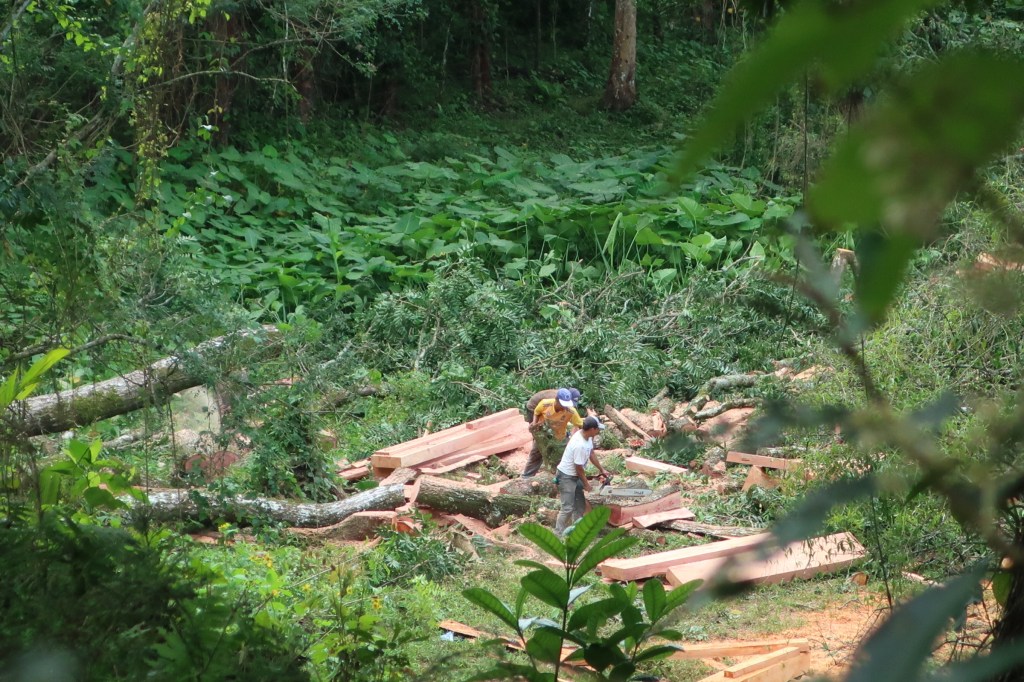
 PeterVanderBloomer.com